
A lot of Western Washington homeowners start this search the same way. Rain is tapping on the windows, the roof is getting older, and there’s that nagging thought in the back of the mind. If this roof has to be replaced, what holds up here?
That question matters more around Puget Sound than it does in a dry climate. Long rainy stretches can hide problems until a ceiling stain shows up. Moss can hold moisture on the roof surface. Tree debris from firs and cedars can keep valleys and roof edges wet for longer than they should be. In places like Redmond, Sammamish, and Snohomish County, homeowners often don’t just want a roof that looks good on day one. They want one that still performs after years of wet weather.
Metal roofing comes up fast in that conversation, and for good reason. It’s a popular option for homeowners who want durability and a cleaner look than an aging composition roof. But then the next question hits. Should the home get a standing seam metal roof or a screw-down metal roof?
That’s where many homeowners get stuck. On paper, both are metal roofs. In real life, they behave very differently once years of rain, debris, and movement from changing temperatures start doing their work.
Introduction Choosing a New Roof in a Rainy Climate
A homeowner in Seattle or Bellevue usually isn’t shopping for a new roof because roofing sounds fun. It usually starts with concern. Maybe the current roof is near the end of its life. Maybe there’s been a repair already, and now another damp spot appears after a week of steady rain. Maybe the home sits under tall trees, and the roof never seems to fully dry out.
That’s why the choice between metal roofing systems needs to be practical. It’s not only about curb appeal or the lower bid. It’s about how the roof handles water, how often it needs attention, and how much risk it creates when maintenance gets delayed.
Metal roofing can be a strong fit in Western Washington. But when homeowners compare standing seam metal roof vs screw down, the core issue is how each roof deals with the weather this region experiences. One roof design does a better job keeping the fastening points protected from rain. The other keeps the upfront price lower, but it asks more from the homeowner later.
Here’s a quick side-by-side look before getting into the details:
| Feature | Standing Seam Metal Roof | Screw-Down Metal Roof |
|---|---|---|
| Fasteners | Concealed under the panels | Exposed on the face of the panels |
| Panel connection | Interlocking raised seams | Panels fastened directly through the metal |
| Movement with temperature changes | Designed to allow movement | More stress lands on screws and washers |
| Maintenance needs | Lower ongoing maintenance | More frequent attention |
| Best fit | Primary homes and long-term ownership | Budget-focused projects, garages, outbuildings |
For a homeowner trying to make a smart long-term choice, that difference is the whole story.
The Snippet Answer Standing Seam vs Screw Down in a Nutshell
Standing seam metal roof vs screw down comes down to one main difference. A standing seam roof hides its fasteners under raised seams, while a screw-down roof has exposed screws through the metal surface. Standing seam systems often last 30 to 50 years when properly installed and usually need less maintenance, while screw-down roofs cost less upfront but need more attention over time, according to this industry comparison.
How They Are Built A Tale of Two Fasteners
The biggest difference isn't color, style, or even the panel profile. It's how the roof is attached.
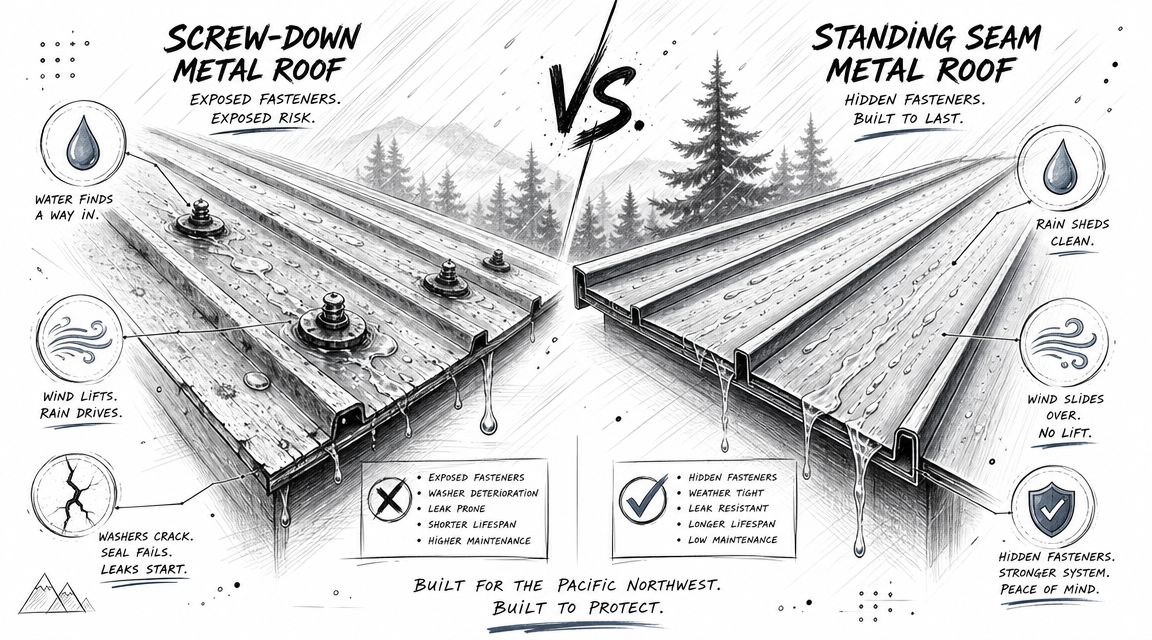
A screw-down roof is exactly what it sounds like. The installer places the metal panel and drives screws right through the face of the metal into the structure below. Those screws stay visible. Each one has to keep water out while also holding the panel in place through years of weather.
A standing seam roof works differently. The panels connect with raised seams, and the fasteners are concealed below those seams. That means the roof surface doesn't have rows of exposed screws taking direct weather every day.

Homeowners who want to see how that concealed-fastener design comes together can get a clearer picture from this page on installing standing seam roofing.
What exposed fasteners mean on a real home
Think about a rainy season in Shoreline or Burien. The roof gets wet, dries a bit, then gets wet again. Debris can sit on the roof. Moss can hold moisture in shaded areas. In that setting, every exposed screw and washer matters.
With a screw-down system, those fasteners are out in the open. That doesn't mean the roof fails right away. It means the roof has many surface penetrations that need to stay sealed over time.
For homeowners, that usually means:
- More maintenance points: Each exposed screw is one more place that needs periodic checking.
- More weather exposure: Washers and screws sit where rain, UV, and debris hit them directly.
- More leak risk over time: If a fastener loosens or the seal weakens, water has a path.
What concealed fasteners change
A standing seam roof reduces that exposure by design. The seams stand up above the flat panel area, and the fasteners stay hidden.
That gives homeowners two practical benefits. First, there are fewer weather-exposed points on the face of the roof. Second, the roof has a cleaner appearance, which many people prefer on a primary residence.
A roof doesn't have to fail all at once to become a problem. In Western Washington, small weak points often show up first as recurring maintenance.
Performance in the Pacific Northwest Which Roof Handles Our Weather Better
A metal roof in Western Washington does not usually fail from one dramatic weather event. It gets tested by months of rain, wet debris sitting in valleys, moss in shaded areas, and wind pushing water where it does not belong. For a Puget Sound home, the better roof is the one that keeps those small problems from turning into leaks ten or twenty years down the road.
Durability and leak risk
In our climate, leak risk is the first question that matters.
Standing seam usually performs better on homes in long wet seasons because the fasteners are concealed instead of exposed on the face of the panel. A screw-down roof can hold up for years, but it asks every screw and washer to keep doing its job while rain, UV exposure, debris, and normal panel movement work on those points over time.
That difference shows up most clearly on older roofs. On a screw-down system, one backed-out fastener or one dried washer may not cause a major leak right away, but it creates a weak spot. On a roof that stays damp for much of the year, weak spots tend to multiply.
Standing seam gives water fewer direct paths through the panel surface. That does not make it leak-proof. Bad flashing, poor trim work, and sloppy installation can still cause problems. But for a primary residence in Western Washington, concealed fasteners are the safer design.
Handling movement from changing temperatures
Metal moves every year, even in our milder climate. Cool mornings, warm afternoons, summer sun, and winter cold all make panels expand and contract.
Standing seam handles that movement better because the panels are designed to move with less stress at the attachment points. Screw-down panels are fastened through the face, so that movement puts more strain on the screw holes and washers over time. That is one reason exposed-fastener roofs usually need closer inspection as they age.
Homeowners do not need to get lost in the engineering. The practical takeaway is simple. A roof system that can move without working its fasteners loose usually gives fewer problems in year 15 than one that cannot.
Debris, moss, and long wet seasons
Western Washington is set apart from drier parts of the country.
In places like Edmonds, Woodinville, or North Bend, roofs often sit under firs, cedars, and maples. Needles collect behind chimneys. Leaves gather in valleys. Moss starts on the north side where sunlight is limited. Once that buildup stays wet, the roof spends more time holding moisture instead of shedding it.
A screw-down roof has more exposed hardware sitting in those conditions. A standing seam roof has fewer weather-exposed points on the field of the roof, so it is generally more forgiving if cleanup gets delayed or a shaded section stays damp longer than it should.
Neither roof is maintenance-free. Branches still need to be cleared. Moss still needs to be addressed before it spreads. Homeowners comparing long-term costs should also look at the cost of a standing seam roof in the context of the maintenance they are likely to face on a tree-covered lot.
Maintenance over the years
This is the part many homeowners underestimate.
A screw-down metal roof can be a reasonable choice on the right building, especially where budget matters and the owner plans to stay on top of inspections. On a Puget Sound home, though, it usually means more recurring attention. Fasteners need to be checked. Washers age. Debris has to be removed before it traps moisture around penetrations and trim.
Standing seam is usually the better fit for homeowners who want less hands-on upkeep and fewer leak-prone details exposed to weather year after year. If the goal is a roof that handles Western Washington rain with less fuss, standing seam is the smarter choice for most homes.
The Financial Picture Upfront Cost vs Lifetime Value
A lot of Puget Sound homeowners get the same surprise. The lower bid looks good on paper, then the roof has to earn its keep through years of rain, fir needles, moss treatment, and the occasional repair call.
That is why price and value are not the same thing.
A screw-down roof usually wins on upfront cost. Materials are less expensive, installation is more straightforward, and that can make it the right call for a tight budget or a secondary structure. On a primary home in Western Washington, though, the cheaper starting number can fade fast if the roof needs more service over the years or reaches the end of its useful life sooner.
Standing seam usually costs more at the beginning because the panels and trim package are more involved and the installation demands more precision. The trade-off is long-term. Fewer exposed fastening points on the field of the roof usually means fewer common leak locations to chase as the years add up.
50-Year Metal Roof Cost Scenario Example
| Cost Factor | Screw-Down (Exposed Fastener) | Standing Seam (Concealed Fastener) |
|---|---|---|
| Initial cost | Lower upfront | Higher upfront |
| Maintenance burden | More frequent inspection and repair work | Lower ongoing service needs |
| Chance of replacement during long ownership | Higher | Lower |
| Fit for a long-term primary residence | Often weaker value over decades | Often stronger value over decades |
I usually tell homeowners to ask a simple question. "What will this roof cost me to own, not just to buy?"
That changes the conversation.
If a homeowner plans to stay in the house for a long time, standing seam often pencils out better even with the higher initial bid. If the plan is to cover a shop, detached garage, or house that may be sold sooner, screw-down can still be a practical choice. For homeowners pricing the premium option, this guide to the cost of a standing seam roof gives a useful breakdown of what usually drives that number.
What this means for resale and peace of mind
Buyers in places like Edmonds, Kirkland, or anywhere under heavy tree cover may not know roofing terms, but they do notice signs of risk. Staining, aging fasteners, patch history, and a roof that looks like it needs attention can affect how they view the house.
A cleaner, longer-term system often carries more confidence with it. That matters in a market where roofs spend months wet and small problems do not stay small for long.
For most Puget Sound homes, the smartest financial choice is the one that reduces future trouble, not just the one that trims the first invoice.
Which Metal Roof is Right for Your Puget Sound Home
The right answer depends on the building, the budget, and how the homeowner plans to use the property.
For a main residence, the decision often comes down to risk tolerance. Does the homeowner want the lower upfront number, knowing the roof will need more regular attention? Or does the homeowner want a roof designed to reduce those long-term trouble spots?
A screw-down roof may fit if
- The project is budget-first: A homeowner may need the lower upfront cost to get the project done now.
- The building is secondary: Garages, shops, and other outbuildings are often where this system makes the most sense.
- Maintenance won't be ignored: If the owner is committed to regular inspections and timely repairs, a screw-down roof can be a workable choice.
This is often the practical route when the goal is function over long-term convenience.
A standing seam roof usually makes more sense if
- The roof is going on the main home: Most homeowners want stronger long-term protection where the family lives.
- Leak prevention matters more than the cheapest bid: In Western Washington, small water-entry issues can turn into interior damage if they're missed.
- The homeowner plans to stay put: A longer-lasting, lower-maintenance roof is easier to justify when the house is a long-term home.
- The home sits in a demanding environment: Heavy tree cover, regular debris, and long wet seasons all push the decision toward concealed fasteners.
A simple way to think about it
A screw-down roof is often the economical choice for a structure where future maintenance is acceptable.
A standing seam roof is usually the smarter choice for a Puget Sound home where the roof needs to keep performing through years of rain with fewer chances for small leak points to develop.
Homeowners in Western Washington often aren't choosing between a cheap roof and an expensive roof. They're choosing between a roof that asks for more attention and one that asks for less.
Why Professional Installation is Non-Negotiable for Metal Roofs
Even the right material can turn into the wrong roof if the installation is sloppy.
Metal roofing has to be laid out carefully. Flashing around chimneys, skylights, vents, and roof-to-wall transitions has to be handled with precision. Underlayment matters. Panel alignment matters. On a standing seam roof, the fastening and clip details matter because that's what allows the system to perform the way it's supposed to.
For homeowners, the biggest risk isn't always choosing the wrong metal roof type. It's assuming any crew can install metal roofing correctly just because the panels look straightforward. In reality, the details decide whether the roof stays dry year after year.
A good installer should be ready to explain:
- How penetrations are waterproofed: Pipes, vents, skylights, and chimneys are common leak zones.
- What maintenance the homeowner should expect: This should be clear before the job starts.
- How the roof is matched to local weather: A roof in Western Washington needs planning for moisture, debris, and long wet periods.
At Four Seasons Roofing's standing seam metal roofing company page, homeowners can see the kind of standing seam work handled across the Seattle area. Their certified team installs standing seam systems as one option for homes that need a long-term metal roofing solution.
Homeowners who want to vet any contractor carefully can also look at resources outside the roofing space, including this marketing guide for roofing contractors. It helps show what a company chooses to communicate publicly, which can give homeowners a better sense of how transparent and established that business appears before scheduling an inspection.
Frequently Asked Questions About Metal Roofing
Are metal roofs noisy when it rains?
Usually, no. On a house with solid roof decking, underlayment, insulation, and an attic space, a metal roof often sounds far more normal than homeowners expect, even during a long Western Washington rain.
The louder examples people remember are often older barns, sheds, or homes with open framing and very little insulation.
Can a metal roof be repaired, or does it always need replacement?
Repairs are possible in many cases. A flashing problem, a failed boot around a vent, loose trim, or damage limited to one area may be fixable without replacing the whole roof.
The decision usually depends on pattern and age. If leaks keep showing up in different spots, if fasteners are backing out across the roof, or if corrosion has started in multiple areas, replacement is often the less expensive choice over time.
Is standing seam always better than screw-down?
Standing seam is usually the smarter choice for a primary home in the Puget Sound area because it has fewer exposed fasteners and generally asks for less attention as the years go by.
Screw-down still has a place. It can be a practical option for a garage, shop, covered parking area, or a homeowner who needs a lower upfront price and understands that maintenance will come sooner and more often. In our wet climate, that trade-off matters more than it does in drier parts of the country.
How does a homeowner know if this applies to their house?
Look at the conditions around the home. Heavy tree cover, moss growth, fir needles in the valleys, slow drying shade, and a roof design with lots of penetrations all put more stress on a metal roof system in Western Washington.
It also matters more for homeowners planning to stay put. If the goal is one roof decision that holds up through years of rain, debris, and routine maintenance, the difference between these two systems is not minor.
Should homeowners inspect a metal roof themselves?
A ground-level check is fine.
Homeowners can watch for debris collecting in valleys, loose-looking ridge or trim pieces, stains on interior ceilings, and damp spots near skylights, chimneys, or vents. Walking on the roof is a different story. It creates a safety risk and can damage panels, especially on slick or wet surfaces.
What should a homeowner do next if they're deciding between these two systems?
Get a roof inspection and ask for both options to be priced for your specific home. A useful estimate should explain more than material cost. It should cover likely maintenance, leak risk around fasteners and penetrations, how the roof sheds debris, and how the system fits a house that sits through months of damp weather each year.
If a homeowner is weighing standing seam metal roof vs screw down and wants an answer based on Western Washington weather, the safest next move is to schedule an inspection with Four Seasons Roofing. A qualified roofer can evaluate the home, explain which system fits the roof best, and help the homeowner choose a roof built for the long haul.