
Standing in the driveway with a handful of metal color chips can feel strange. You’re not just picking a color. You’re making a decision you’ll see in the rain, under summer sun, and every time you pull into the house after work.
Most homeowners start with looks, and that makes sense. But in the Puget Sound area, tin roof colors also affect how warm your attic gets, how much dirt and moss you notice, and how the roof will look years from now. If your home sits under tall trees in Redmond or Sammamish, that matters. If you’re closer to the water in Shoreline or Burien, that matters too.
A good color choice should do three things. It should fit your home, hold up well, and feel low-stress to live with.
Your New Roof is a Big Decision Let’s Get the Color Right
A lot of homeowners reach the color stage and suddenly feel stuck. The roof style is chosen. The budget is set. Then someone lays out white, gray, bronze, green, and black samples, and now the pressure kicks in.
That reaction is normal.
A roof lasts a long time, so the color feels bigger than paint on a wall. You can’t test it for a month and repaint it if you change your mind. You want it to look right from the street, but you also don’t want a choice that creates more upkeep than you expected.
What makes this harder in Western Washington
National advice usually pushes one simple message: pick a light color to reflect heat. That’s useful, but it doesn’t answer the questions local homeowners ask.
Those questions sound more like this:
- Will this color show moss fast if my home sits under fir trees?
- Will rain streaks stand out on a bright panel?
- Will this still look good in ten or twenty years with our cloudy skies and wet winters?
- Will it clash with my brick, cedar, or trim color?
Homeowners often make similar long-term material choices inside the house too.
Your roof color isn’t just curb appeal. It’s part of how your home handles weather, maintenance, and aging.
A simple way to think about the choice
To simplify the decision, it’s often best to narrow it to three filters:
| What to check | Why it matters for your home |
|---|---|
| Heat performance | Helps you understand how much sun the roof absorbs |
| Appearance over time | Affects how quickly dirt, pollen, and streaks show |
| Style fit | Keeps the roof looking like it belongs on your house |
If you’re noticing decision fatigue already, that’s a sign to slow down, not rush. The right color usually becomes clearer when you look at it through real homeowner concerns instead of just a tiny sample card.
How Roof Color Can Affect Your Energy Bills
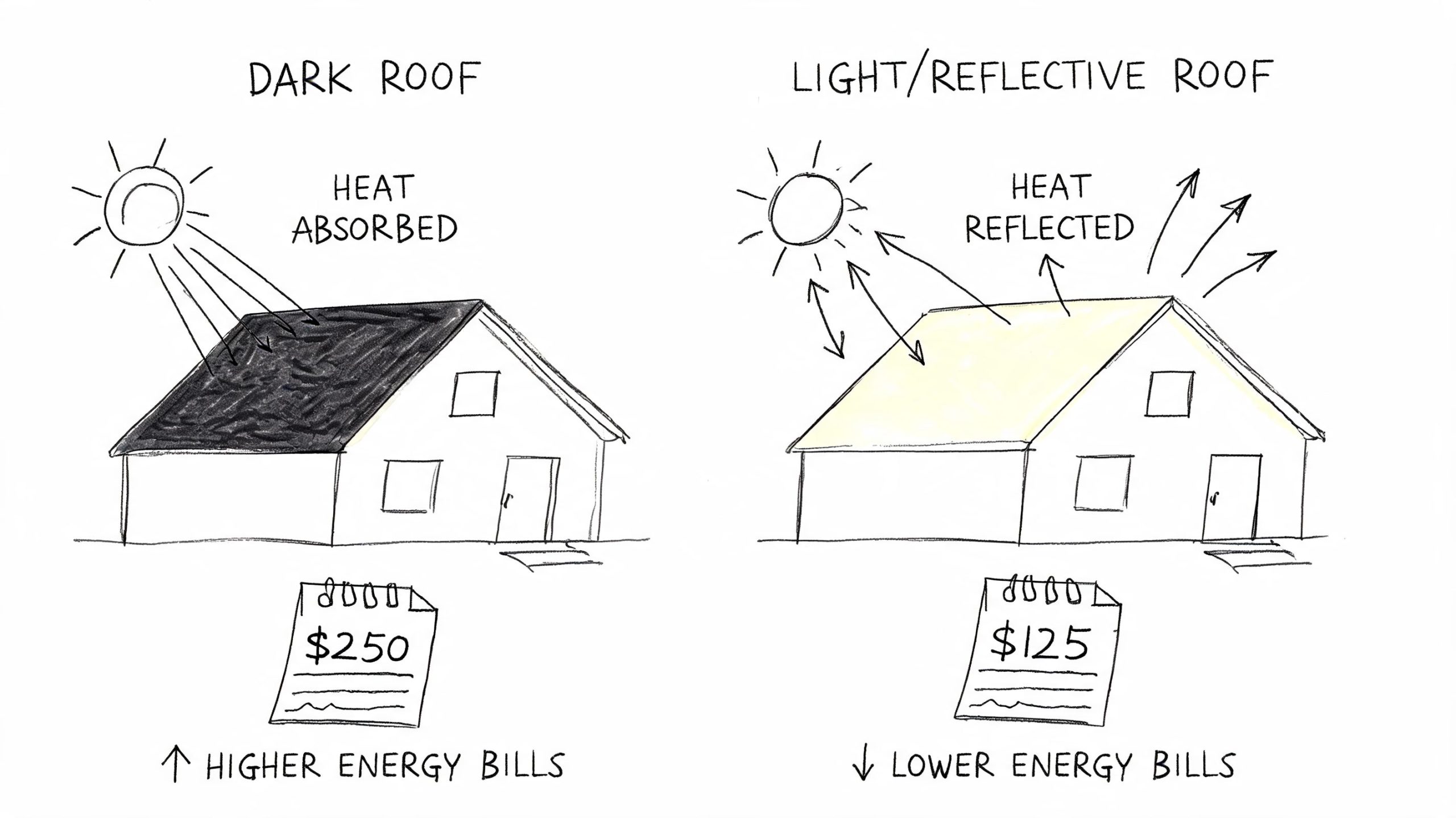
Roof color changes how much heat your roof takes in from the sun. The easiest way to understand it is clothing. A white T-shirt on a sunny day usually feels cooler than a black one because it reflects more sunlight instead of soaking it in.
Metal roofs work the same way.
What Solar Reflectance means in plain English
You may hear the term Solar Reflectance Index, often shortened to SRI. That sounds technical, but the basic idea is simple. It’s a way to measure how well a roof surface reflects heat and releases it.
Higher SRI usually means a cooler roof surface.
For example, Solar White paint reaches SRI 82 in cool metal roofing standards, while Medium Bronze is listed at SRI 31 in the same reference from Sheffield Metals on cool metal roofing and SRI. You don’t need to memorize those numbers. What matters is the direction. Lighter colors generally reflect more heat.
What the real-world data shows
This isn’t just theory. In a roof study, houses with white-painted metal roofs averaged 29.8°C indoors in the evening, which was 1.7°C cooler than homes with unpainted bare metal roofs, according to the roof performance study on metal roof color and indoor temperature. Red roofs were also cooler than bare metal.
Here’s what that means for your home. A cooler roof can mean a cooler attic. A cooler attic can reduce how hard your home has to work during warmer stretches.
Practical rule: If your upstairs gets stuffy every summer, a lighter roof color may help more than you’d expect.
Does this still matter in Seattle-area weather
Yes, but in a local way.
We don’t get the same long, intense heat as hotter inland climates. Still, many homeowners around Seattle, Everett, and Snohomish notice that upper rooms heat up during warm weather. A more reflective metal roof can help reduce that heat buildup.
At the same time, color isn’t only about energy here. If you’re weighing efficiency first, this guide on which roof color has highest energy efficiency gives a useful starting point.
The homeowner takeaway
If lowering heat gain is high on your list, these tin roof colors usually move to the top:
- White and off-white for the strongest heat reflection
- Light gray for a softer look with similar benefits
- Light blue or sandstone-style tones if you want something lighter without going bright white
If you’re choosing between beauty and performance, you often don’t have to pick just one. Many medium and light colors give you a balanced result.
Understanding Roof Finishes and Color Durability
A metal roof’s color isn’t just paint sitting on top. On a quality roof, that color is part of a protective finish designed to shield the metal from weather, sunlight, and wear.
That matters because many homeowners still picture old painted outbuildings with peeling surfaces and faded panels. Modern metal roofing is very different.
The color is part of the protection
One finish you’ll hear about often is Kynar 500. In plain language, think of it as a tough outer shell. It helps the roof keep its color and resist breakdown from years of exposure.
According to Sheffield Metals’ overview of cool metal roofing coatings, modern metal roof paints, especially high-quality Kynar 500 coatings, are designed to last 30 to 40 years, while the roof itself may last 40 to 70 years. The same source notes that these coatings are certified through programs such as ENERGY STAR to help maintain solar reflectance and color vibrancy over time.
What that means for your home
If you’re replacing an aging roof, this should be reassuring. You’re not choosing a color that’s likely to look tired after a few rainy seasons. You’re choosing a factory-applied finish built for long-term exposure.
Here’s why homeowners care about that:
- Fade resistance helps the roof keep a more consistent look over time
- Surface protection helps defend the metal underneath
- Color stability matters when your roof is one of the largest visible parts of the home
A quality finish does two jobs at once. It protects the panel, and it protects the look you paid for.
Not all finishes feel the same visually
Even within similar colors, the finish changes the experience. A glossy finish can look sharper and brighter. A lower-sheen finish can feel softer and may be more forgiving when pollen, dust, or water spots show up.
That’s why the sample itself matters. A small chip viewed indoors can mislead you. Outdoors, the same gray may look bluer, warmer, or darker depending on the time of day and your siding color.
| Finish trait | What homeowners often notice |
|---|---|
| Brighter sheen | Stronger visual contrast, more light reflection |
| Softer sheen | A quieter look, often easier to live with day to day |
| Premium coating | Better long-term confidence in color retention |
If you’re noticing old paint failure on an existing metal roof, that’s a separate issue from choosing factory-finished panels for a replacement. The important point is that modern colored metal roofing is built as a long-term exterior system, not a short-term cosmetic layer.
The Best Tin Roof Colors for the Puget Sound Climate
A lot of roofing advice online assumes you live somewhere hot and sunny. That’s only part of the story here. In Western Washington, cloud cover, rain, fir needles, pollen, and moss all shape how a roof color feels to own.
That’s why the best tin roof colors for a Puget Sound home are not always the lightest ones.

What local homeowners actually deal with
Most online advice focuses on heat savings, but there’s limited guidance for Western Washington’s cloudy, high-rainfall weather. For homeowners here, a color’s ability to hide moss growth or resist streaking from constant rain can matter more for long-term satisfaction than SRI, as noted by Classic Metal Roofs on choosing color in different climates.
If your home sits beneath tall trees in Sammamish or Redmond, you’ve probably seen how quickly organic debris builds up. If you’re near the water in places like Burien or Shoreline, you may pay closer attention to wear and surface appearance than someone farther inland.
Four color families that usually make sense here
Instead of chasing one “best” color, it helps to think in families.
-
Soft whites and off-whites
Good for homeowners who want the brightest, cleanest look and stronger heat reflection. They can show grime and streaking more clearly, so they’re often best for homes with strong sun exposure and less tree cover. -
Light to medium grays
These are some of the safest choices in the Puget Sound. They feel modern, work with many siding colors, and usually strike a good balance between showing too much dirt and absorbing too much heat. -
Bronze and earthy neutrals
These can be a smart fit on homes surrounded by trees or natural landscaping. They tend to feel grounded and often blend well with wood, stone, and muted trim colors. -
Deep charcoal or green tones
These create drama and can suit Craftsman or cabin-like homes. They may absorb more heat, but many homeowners choose them because they feel richer and can make the whole exterior look more intentional.
In our region, “best color” often means the one you’ll be happiest looking at after months of rain, not just the one with the highest reflectivity.
One local factor people forget
Winter weather still matters. Snow and ice don’t define our whole climate, but they do show up in parts of the region and on certain roof shapes. If your home is in a colder pocket or on a slope that holds winter moisture longer, this guide on how snow and ice impact your roof can help you think through the full picture.
Matching Your Roof to Your Home’s Style and Neighborhood
Color choice gets easier when you stop asking, “What’s the best roof color?” and start asking, “What looks right on my house?”
A roof can look beautiful on a sample board and still feel wrong once it’s installed. That usually happens when the color doesn’t match the home’s style, trim, or setting.

Common local home styles and good color directions
Across the Seattle area, a few patterns show up again and again.
Craftsman homes
Older Craftsman homes in neighborhoods like Ballard often have earthy materials, visible trim, and a grounded feel. These homes usually pair well with:
- charcoal
- deep bronze
- muted green
- weathered gray
These colors tend to respect the home’s character instead of overpowering it.
Northwest contemporary homes
Modern homes in places like Kirkland often look best with cleaner contrast. If the siding is crisp and the lines are simple, homeowners often lean toward:
| Home look | Tin roof colors that often fit |
|---|---|
| Modern and high contrast | Black, charcoal, cool gray |
| Warm modern | Bronze, sandstone, muted taupe-gray |
| Soft contemporary | Light gray, off-white, pale neutral |
A darker roof can look striking here, especially with light siding and black window frames. But the color should still feel connected to the rest of the exterior.
Traditional homes with brick or beige siding
These homes usually benefit from restraint. A roof that’s too bold can make the whole house feel mismatched. Medium grays, bronzes, and softer neutrals often work better than sharp black or bright white.
Some of the best-looking roofs are not the ones that stand out first. They’re the ones that make the whole house look settled and finished.
Look beyond the house itself
Your neighborhood matters too. A roof doesn’t sit in isolation. It becomes part of the street view.
If every home nearby uses muted, natural colors, a very bright or very dark roof may feel out of place. That doesn’t mean you have to copy the neighbors. It means you should think about how your home will fit into the block.
This comes up with detached shops and backyard structures too. If you’re comparing how metal colors look across separate buildings, ideas from designing custom workshops can be surprisingly helpful because they show how roof and wall colors work together as one composition.
A quick way to test your choice
If you’re narrowing down options, compare each color against these three questions:
-
Does it match the fixed parts of the house?
Brick, stone, trim, and window color are harder to change than paint. -
Will it still look right in winter?
Some colors look very different under gray skies than they do in bright sun. -
Do you want contrast or harmony?
Contrast creates drama. Harmony creates a calmer, more classic look.
If you want more inspiration from a residential perspective, this guide on how to choose roof shingle color is useful even if you’re considering metal. The same visual principles still apply.
Long-Term Care for Your New Colored Tin Roof
Once the roof is installed, most homeowners want two things. They want it to keep protecting the house, and they want it to keep looking good without becoming another constant chore.
Color plays a role in that.
Some roof colors are more forgiving than others. According to RoofSnap’s discussion of long-term metal roofing color choices, when choosing a color for a 25-year lifespan, it helps to think about aesthetic durability. Some colors, including natural patina-style looks, age gracefully and hide imperfections better, while others may need more frequent cleaning in high-rainfall, moss-prone environments like Western Washington.
What maintenance looks like in real life
If your home is under tree cover, debris and moss are the main things to watch. If the roof gets a lot of open-sky exposure, you may notice dirt, water marks, or pollen first.
A few realistic expectations help:
- Bright light colors can show grime and runoff sooner
- Medium neutrals often hide everyday buildup better
- Very dark colors may show pollen, dust, or residue depending on the season
Simple habits that help
You don’t need to fuss over a metal roof, but you should pay attention to it.
- Clear debris early so wet leaves and needles don’t sit in valleys and edges
- Check shaded areas if one side of your roof stays damp longer than the rest
- Use gentle cleaning methods because aggressive scrubbing can damage the finish
- Schedule inspections if you’re seeing streaks, loose trim, or anything unusual around seams and fasteners
Homeowner note: The easiest roof to live with is usually the one that matches both your style and your tolerance for visible dirt.
For practical upkeep advice after installation, this guide on how to maintain a metal roof is a good reference.
How We Help You Choose Your Roof Color with Confidence
Most homeowners don’t need more color swatches. They need clarity.
That usually starts when you see the sample at your own house, next to your siding, trim, brick, and landscaping. A gray that looked perfect on a screen may suddenly read blue. A black panel that looked sharp in a showroom may feel too heavy under a cloudy sky.

What helps homeowners feel sure
The best decisions usually come from seeing the roof color in context, not guessing from a brochure.
A helpful process tends to look like this:
-
Look at the whole exterior
Roof, siding, trim, gutters, masonry, and even the shade from nearby trees all affect how a color reads. -
Narrow to a few realistic options
Too many choices create stress. Three strong options are usually easier than fifteen. -
Balance style with upkeep
A color can be beautiful and still be wrong for how you want to live. If you don’t want to notice every streak or bit of moss, that should shape the decision.
What this means for your home
If you’re replacing a roof because of leaks, age, or storm wear, color shouldn’t feel like a separate design puzzle. It should be part of a smarter overall choice for the home.
That’s especially true in Western Washington, where weather and surroundings affect the experience so much. A home under dense tree cover may need a different answer than the same house on a sunnier lot a few miles away.
You don’t need to pick the “perfect” color in theory. You need the color that makes sense on your house, in your setting, for the way you live.
If you’re unsure where to start, it helps to talk through the roof’s condition, the surroundings, and the look you want before locking in a final choice.
If you’re comparing tin roof colors and want help sorting out what will look right and hold up well on your home, Four Seasons Roofing can help. Their team has served Western Washington homeowners since 1996, and they can walk you through roof condition, material options, and color choices in a clear, low-pressure way so you can move forward with confidence.