
Your roof is more than just shingles and beams; it is a complete system designed to protect your home. A critical, yet often overlooked, component of this system is proper attic ventilation. In the damp climate of Western Washington, an effective ventilation strategy is the frontline defense against moisture buildup, ice dams, and premature roof aging.
A well-ventilated attic acts as your home’s lungs, circulating air to regulate temperature, reduce energy costs, and extend the life of your entire roofing structure. Beyond maintaining proper temperatures, good attic ventilation is crucial in helping to prevent mold around air vents and within the attic itself, safeguarding your home’s structural integrity and indoor air quality. However, with so many options available, choosing the right system can feel overwhelming.
This comprehensive guide breaks down the eight most common attic vents types, from ridge and soffit vents to powered and solar options. We will provide clear, actionable insights to help you make an informed decision for your specific roof and climate. We will explore how each type functions, its ideal application, and specific considerations for Puget Sound homes, empowering you to protect your most valuable asset.
1. Ridge Vents
Ridge vents are among the most effective and aesthetically pleasing attic vents types available. Installed continuously along the entire peak (the ridge) of a sloped roof, they create a uniform, low-profile exhaust system. This design allows hot, moist air, which naturally rises, to escape from the highest point of the attic.
This system operates on the principle of thermal convection. As hot air exits through the ridge vent, it creates a negative pressure zone that pulls cooler, drier air into the attic through intake vents located along the eaves, known as soffit vents. This constant, gentle airflow prevents heat buildup in the summer and moisture accumulation in the winter, protecting your roof structure and improving energy efficiency.
Why Choose a Ridge Vent?
For most modern residential homes in Western Washington with asphalt shingle roofs, a ridge vent is the gold standard. Its continuous design provides balanced ventilation across the entire attic space, eliminating hot or damp spots that can occur with other, more localized vent types.
Key Insight: A properly balanced ridge and soffit vent system is a passive, non-mechanical solution that works year-round without consuming electricity or requiring moving parts that can fail.
Implementation and Best Practices
To ensure a ridge vent performs optimally, follow these essential guidelines:
- Pair with Soffit Vents: A ridge vent is only half of the system. It must be paired with an equal or greater amount of soffit intake ventilation to create proper airflow. The ideal is a 50/50 balance between intake and exhaust.
- Ensure Proper Installation: The roofer must cut a precise slot in the roof sheathing along the ridge, but not so wide as to compromise structural integrity. The vent is then installed over this opening and covered with matching shingles.
- Clear the Soffit Vents: Make sure your soffit vents are not blocked by insulation, debris, or paint. If gutters are installed improperly, they can also obstruct airflow.
A professional installation by a certified team like Four Seasons Roofing is critical. We ensure the vent is installed correctly with proper underlayment and flashing to prevent leaks, a common issue with DIY or inexperienced installations.
2. Soffit Vents
Soffit vents are the essential intake component of a balanced attic ventilation system. Installed in the soffit—the architectural term for the underside of a roof’s overhang or eaves—these vents allow cool, fresh air to enter the attic. They are a foundational element among attic vents types, working in partnership with exhaust vents to create the airflow needed to protect your home.
This system relies on natural air movement. As exhaust vents like ridge or gable vents expel hot, moist air from the attic’s peak, a pressure difference is created. This difference pulls cooler, drier air from the outside into the attic through the soffit vents. This continuous cycle moderates attic temperatures and humidity levels year-round, preventing common issues like ice dams, mold growth, and premature shingle deterioration.
Why Choose Soffit Vents?
For nearly any home in Western Washington with roof overhangs, soffit vents are not just a choice; they are a necessity. They provide the critical intake airflow that makes exhaust vents effective. A roof with only exhaust vents will struggle to ventilate properly and can even pull conditioned air from your living space, reducing energy efficiency.
Key Insight: Soffit vents are the “intake” part of your attic’s breathing system. Without proper intake, even the most powerful exhaust vents cannot function correctly, leading to a poorly ventilated, unhealthy attic.
Implementation and Best Practices
To maximize the effectiveness of your soffit vents, proper planning and installation are crucial. Follow these best practices:
- Install Baffles: Always install baffles (also known as insulation stops) where the attic floor meets the roofline. This creates a clear channel for air to flow from the soffit vent into the attic, preventing insulation from blocking the opening.
- Prioritize Continuous Venting: Whenever possible, opt for continuous soffit vents over individual, smaller vents. This design provides more consistent and evenly distributed airflow along the entire lower edge of the roof.
- Annual Cleaning: At least once a year, inspect and clean your soffit vents. They can become clogged with dust, cobwebs, and debris, which severely restricts airflow.
- Calculate Correct Intake: The general rule is to have at least a 50/50 balance between intake (soffit) and exhaust (ridge) ventilation. Understanding the key role of attic ventilation ensures your entire system is properly sized.
A professional team like Four Seasons Roofing can assess your home’s unique structure to determine the optimal type and amount of soffit ventilation needed. We ensure that your intake vents are correctly installed and clear of obstructions, guaranteeing your attic ventilation system performs as intended from day one.
3. Gable Vents
Gable vents are one of the most traditional and recognizable attic vents types, often serving both functional and aesthetic purposes. Installed on the exterior walls at the triangular, uppermost part of a gabled roof, these vents allow air to pass through the attic space. They are typically louvered to prevent rain and pests from entering while still permitting airflow.
This system functions by utilizing natural wind pressure. As wind blows against one side of the house, it pressurizes that side and pushes air into the attic through the gable vent. Simultaneously, a low-pressure zone is created on the opposite side, which pulls the warmer, stagnant attic air out through the other vent. This cross-ventilation helps moderate attic temperatures and reduce moisture.
Why Choose a Gable Vent?
Gable vents are excellent for homes with distinct gable-end architecture, such as traditional Farmhouse, Cottage, or New England colonial styles. They can be selected in various shapes like triangles, squares, or circles to complement the home’s design. While often seen on older homes, they can be effective when used as part of a modern, balanced ventilation plan.
Key Insight: Gable vents rely heavily on wind to function effectively. On calm days, their passive ventilation capability is significantly reduced compared to systems that use natural convection, like a ridge and soffit combination.
Implementation and Best Practices
To maximize the effectiveness of gable vents and prevent common issues, adhere to the following guidelines:
- Combine with Soffit Vents: For improved airflow, gable vents should be used as exhaust vents in combination with soffit intake vents. This creates a more reliable system that does not solely depend on wind direction for air exchange.
- Avoid Mixing with Ridge Vents: Never use gable vents and ridge vents together. This combination can disrupt the natural convection path, causing the ridge vent to pull air in from the gables instead of the soffits, which short-circuits proper attic ventilation.
- Proper Sizing and Placement: Vents should be installed as high as possible on the gable ends to allow the hottest air to escape. Ensure they are sized correctly for the attic square footage to provide adequate net free vent area.
For homes in Western Washington, it is crucial that gable vents are installed with properly angled louvers and screens to block our region’s frequent wind-driven rain. The expert team at Four Seasons Roofing can assess if gable vents are the right solution for your home’s architecture and ventilation needs.
4. Turbine Vents (Whirlybird Vents)
Turbine vents, often called “whirlybirds,” are a type of wind-driven exhaust vent. They feature a spinning head with fins that catch the wind, creating a vacuum effect that actively pulls hot, humid air out of the attic space. Unlike passive vents, their effectiveness increases with wind speed, making them a dynamic ventilation solution.
This mechanical, non-electric system provides powerful ventilation when conditions are right. The constant rotation helps exhaust attic air more forcefully than static vents, which can be beneficial for homes that generate excess heat or moisture, such as those with steep roofs or large attic volumes. They are commonly seen on garages, workshops, and some residential properties.
Why Choose a Turbine Vent?
In areas with consistent wind, like some coastal communities in Western Washington, turbine vents can be an excellent, energy-free option. They offer more powerful exhaust capabilities than static box vents without the cost and complexity of a powered fan. For buildings like warehouses or large workshops, they provide robust, cost-effective air exchange.
Key Insight: The performance of a turbine vent is directly tied to wind speed. In calm conditions, it functions similarly to a static vent, relying only on natural convection, but its true power is unlocked by consistent airflow.
Implementation and Best Practices
To get the most out of turbine vents, proper selection and installation are crucial:
- Pair with Soffit Vents: Just like ridge vents, turbines are exhaust systems and must be balanced with adequate intake ventilation, typically from soffit vents, to function correctly. Without intake, the turbine can pull conditioned air from your living space.
- Invest in Quality: Opt for models with permanently lubricated, high-quality ball bearings. Cheaper models can become noisy and squeaky over time and may seize up, rendering them useless.
- Strategic Placement: Turbines should be installed as close to the roof’s ridge as possible to capture the most wind and exhaust the hottest air. For larger roofs, multiple smaller turbines often provide more balanced ventilation than one large one.
Proper flashing and sealing around the base of the turbine are essential to prevent leaks. The team at Four Seasons Roofing can assess if your property’s location and roof design are suitable for turbine vents and ensure a watertight, professional installation.
5. Power Vents (Powered Attic Ventilators)
Power vents, also known as powered attic ventilators (PAVs), are active exhaust fans that use electricity to forcefully pull hot, humid air out of the attic. Unlike passive systems that rely on natural convection, these motorized units create consistent, powerful airflow, making them a potent solution for attics with severe heat buildup or inadequate natural ventilation.
These units operate automatically, typically controlled by a built-in thermostat that activates the fan when attic temperatures reach a preset level, such as 100-110°F. By actively expelling superheated air, they prevent heat from radiating into your living spaces, which can significantly reduce the load on your air conditioning system. Many modern units are highly efficient; understanding the basics of DC Fans vs AC Fans can help in selecting a model that balances power with energy consumption.
Why Choose a Power Vent?
A power vent is an excellent choice for complex roof designs where a continuous ridge vent is not feasible, or in homes where passive ventilation is insufficient to combat extreme summer heat. They are also ideal for low-slope or flat roofs common in certain commercial buildings. For homeowners in Western Washington struggling with a stuffy second floor during summer heatwaves, a power vent can provide immediate and noticeable relief.
Key Insight: Power vents can create a “chimney effect” on demand, moving a large volume of air in a short time. This makes them one of the most powerful attic vents types for situations requiring aggressive heat removal.
Implementation and Best Practices
To ensure a power vent works efficiently and does not cause new problems, proper setup is crucial:
- Ensure Massive Intake: A power vent’s aggressive exhaust must be balanced with an abundance of intake ventilation, primarily through soffit vents. Without enough intake, the fan can create negative pressure, pulling conditioned air from your home into the attic, which wastes energy.
- Set Thermostat Correctly: The thermostat should be set to activate only during peak heat, not too low. This prevents the unit from running unnecessarily and extends its lifespan.
- Consider Solar Options: Solar-powered attic fans are an increasingly popular, eco-friendly alternative. They operate during the sunniest, hottest parts of the day when they are needed most, without adding to your electricity bill.
- Professional Electrical Work: These units require electrical wiring. A professional installation by a team like Four Seasons Roofing ensures the unit is correctly wired, mounted securely to prevent vibration and leaks, and integrated safely into your roofing system. You can explore how power vents solve attic overheating in our detailed guide.
6. Roof Louvers
Roof louvers, also known as box vents or static vents, are a classic and straightforward type of attic exhaust vent. These fixed, passive vents are installed directly on the roof’s surface, usually on the rear-facing slope for better aesthetics. They feature angled slats, or louvers, that allow hot, moist air to escape while providing protection from rain and snow.
This type of attic vent operates passively, relying on the natural convection of rising warm air and external wind to draw air out of the attic. While not as efficient as a continuous ridge vent, multiple strategically placed roof louvers can provide effective ventilation for smaller attic spaces, garages, or homes where a ridge vent is not feasible. They create localized exhaust points across the roof deck.
Why Choose a Roof Louver?
Roof louvers are a practical and cost-effective solution for many different roofing systems, especially on older homes or detached structures like sheds and garages. Their simple design means they have no moving parts to wear out, making them a durable, low-maintenance choice. They are also versatile and can be installed on various roof pitches and materials, including metal roofs where other vent types may be unsuitable.
Key Insight: The effectiveness of roof louvers depends heavily on their quantity and placement. They must be installed high up on the roof, as close to the ridge as possible, to maximize the exhaust of hot air.
Implementation and Best Practices
To ensure your roof louvers function correctly and protect your home, consider these essential guidelines:
- Proper Placement and Quantity: Louvers should be evenly distributed across the upper portion of the roof to ventilate the entire attic space. A roofing professional can calculate the exact number of vents needed based on your attic’s square footage.
- Pair with Soffit Vents: Just like ridge vents, roof louvers are exhaust-only. They must be part of a balanced system with adequate soffit vents to pull in fresh, cool air from the eaves.
- Prioritize Quality Installation: Each roof louver requires a separate penetration in the roof deck. Meticulous flashing and sealing are non-negotiable to prevent leaks. This is a common failure point for DIY installations.
- Choose Durable Materials: For the damp Western Washington climate, select louvers made from rust-resistant materials like galvanized steel or aluminum to ensure longevity.
A professional installation by the Four Seasons Roofing team guarantees each louver is perfectly sealed and positioned for optimal airflow, protecting your home from moisture damage and extending the life of your roof.
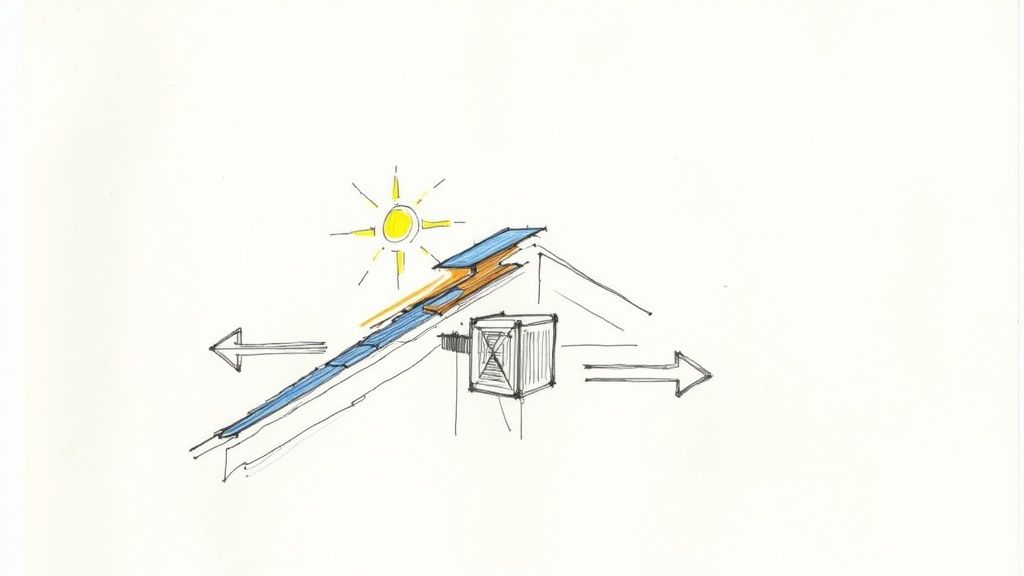
7. Solar-Powered Attic Fans
Solar-powered attic fans, one of the more modern attic vents types, offer a powerful, eco-friendly solution for managing attic temperature and moisture. These active ventilators use a dedicated solar panel to power a fan motor, actively pulling hot, humid air out of the attic space. This creates a more forceful airflow than passive systems, operating entirely off-grid without adding to your home’s electricity bill.
They function similarly to electric power vents but are powered by clean, renewable energy. The integrated solar panel converts sunlight into electricity, which runs the fan. This design makes them an excellent choice for homeowners looking to boost their ventilation system’s performance while minimizing their carbon footprint and long-term operating costs.
Why Choose a Solar-Powered Attic Fan?
For homes in areas that receive decent sun exposure, even in Western Washington, a solar-powered fan can be a game-changer. It provides the high-volume air exchange of a powered fan without the associated energy costs. This makes it a great option for hard-to-ventilate attics or as a supplement to an existing passive system that is not quite getting the job done, especially on hot, still summer days.
Key Insight: Solar-powered attic fans are self-regulating. They work hardest during the sunniest, hottest parts of the day, which is precisely when your attic needs the most aggressive ventilation.
Implementation and Best Practices
To maximize the effectiveness of a solar-powered attic fan, consider these key factors:
- Proper Sizing and Placement: The fan should be installed on a south- or southwest-facing roof plane to capture maximum sunlight. Ensure the unit is sized correctly for your attic’s square footage to achieve adequate air exchange.
- Balance with Intake Vents: Like all exhaust vents, a solar fan must be paired with sufficient soffit vents. Without enough intake air, the fan can create negative pressure, potentially pulling conditioned air from your living space into the attic.
- Regular Maintenance: Keep the solar panel clear of debris, leaves, and moss to ensure it operates at peak efficiency. A gentle cleaning once or twice a year is typically all that is needed. Learn more about the benefits of a solar attic fan and how it can improve your home’s efficiency.
A professional installation from Four Seasons Roofing ensures the unit is mounted securely, flashed correctly to prevent leaks, and positioned for optimal solar gain and ventilation performance. We can also assess your current intake ventilation to confirm your system will be balanced and effective.
8. Cupola Vents
Cupola vents are distinctive, tower-like structures installed on a roof’s ridge, combining architectural elegance with functional attic ventilation. More than just a decorative element, a properly designed cupola allows hot, moist air to escape the attic through louvered or screened openings, functioning as a passive exhaust vent.
These vents operate on the same principle of thermal convection as other passive systems. Hot air rises and exits through the cupola’s openings, creating a pressure difference that helps draw cooler, fresh air into the attic from intake vents like soffits. Their design makes them a popular choice for traditional, farmhouse, and Victorian-style homes where maintaining historical or architectural character is paramount.
Why Choose a Cupola Vent?
A cupola is an excellent choice when aesthetics are as important as function. For architectural styles such as Colonial, Victorian, or modern farmhouse, a cupola adds a striking focal point that enhances curb appeal while contributing to the overall ventilation plan. They are particularly common on barns, sheds, and detached garages, but can be a beautiful addition to a primary residence.
Key Insight: While a cupola provides functional ventilation, its primary value is often its architectural contribution. It can be paired with other, less visible vents like ridge vents to achieve optimal airflow without compromising on style.
Implementation and Best Practices
To ensure a cupola vent is both beautiful and effective, careful planning and installation are essential:
- Balance with Intake: Like all exhaust vents, a cupola must be part of a balanced system. Ensure there is adequate soffit or other intake ventilation to supply the air it will exhaust.
- Proportional Sizing: Select a cupola that is properly scaled to your home’s size and roof pitch. A common guideline is one inch of cupola width for every foot of the roof’s ridgeline.
- Professional Installation: Installing a cupola requires cutting a significant opening in the roof and intricate flashing to prevent leaks. This is a job for an experienced roofer or carpenter.
Due to the complex nature of the installation, a professional team like Four Seasons Roofing is recommended to ensure the cupola is structurally sound and completely weatherproof. We can help you select a design that complements your Western Washington home while integrating it seamlessly into your roof system for long-term performance.
Attic Vent Types: 8-Point Comparison
| Ventilation Type | Implementation complexity | Resource requirements | Expected outcomes | Ideal use cases | Key advantages |
|---|---|---|---|---|---|
| Ridge Vents | Moderate — continuous roof peak installation; professional recommended | Roofing material cut/underlayment; skilled labor; compatible soffit vents | Continuous high exhaust when paired with soffits; balanced attic airflow | Modern residential roofs, energy-efficient new builds | Nearly invisible, effective moisture reduction, long-lasting |
| Soffit Vents | Low–Moderate — installed under eaves; baffles recommended | Soffit material, baffles, moderate labor; periodic cleaning | Reliable intake airflow; enables balanced ventilation with exhaust vents | Standard homes, retrofits, multi-eave roofs | Essential intake, affordable, improves overall system efficiency |
| Gable Vents | Low — wall-mounted openings; simple install; motorized option increases complexity | Minimal materials; optional motor/damper and wiring | Moderate side exhaust; effectiveness varies with wind and layout | Homes with prominent gables, traditional architectures | Low cost, decorative options, can operate passively |
| Turbine Vents (Whirlybird) | Moderate — roof penetration and flashing; bearings require quality install | Mechanical turbine, flashing; low operational cost; regular maintenance | Strong exhaust in windy conditions; variable in calm weather | Windy/coastal areas, commercial roofs, workshops | No electricity, high airflow when windy, affordable initial cost |
| Power Vents (Powered Attic) | High — requires wiring, thermostat, professional installation | Electric fan, thermostat controls, electrical hookup; ongoing energy use | Consistent controlled exhaust regardless of wind; thermostatic control | Hot/humid climates, buildings lacking passive ventilation | Most controllable and reliable; can significantly reduce attic temps |
| Roof Louvers | Low — fixed roof penetration; simple flashing work | Louver units, flashing; minimal maintenance | Passive moderate exhaust dependent on convection/wind | Barns, older homes, garages, metal roofs | Simple, durable, no moving parts, low cost |
| Solar-Powered Attic Fans | Moderate — panel and fan mount; minimal wiring; best on sunny aspects | Integrated solar panel, fan unit, mounting hardware; occasional cleaning | Effective daytime exhaust with zero operating electricity; limited at night/cloudy days | Sunny regions, eco-conscious homes, off-grid properties | Zero operating cost, sustainable, easy retrofit without wiring |
| Cupola Vents | High — structural addition; carpentry and flashing required | Custom cupola structure, skilled labor, higher material cost | Passive 360° ventilation with modest exhaust; primarily aesthetic | Historic/farmhouse properties, high-end estates, barns | Architectural appeal, decorative, provides passive ventilation |
Choosing the Right System for Your Puget Sound Home
Navigating the various attic vents types can feel complex, but the core principle is simple: create a balanced system where cool, dry air enters and warm, moist air exits. As we have explored, the ideal solution for most Western Washington homes is a passive system, typically combining continuous soffit vents for intake with a full-length ridge vent for exhaust. This combination works harmoniously with our region’s climate, effectively preventing moisture buildup, mold growth, and the formation of destructive ice dams without adding to your energy bill.
However, a “one-size-fits-all” approach rarely works for home construction. The unique architecture of your roof, the total square footage of your attic, and even the specific orientation of your home can all influence which ventilation strategy is most effective. A low-slope roof might not have the pitch for a ridge vent, or an older home may have existing gable vents that need to be integrated or sealed. Understanding these nuances is the key to creating a truly functional and protective system.
Key Takeaways for a Healthy Attic
To distill it down, here are the most critical takeaways from our deep dive into attic ventilation:
- Balance is Non-Negotiable: Your ventilation system must have a balanced, or slightly intake-heavy, ratio of intake to exhaust. The general rule is a 50/50 split. An imbalanced system can lead to poor air circulation or even pull conditioned air from your living space, wasting energy.
- Passive is Often Preferred: For the Puget Sound’s climate, passive systems like ridge and soffit vents are highly effective, reliable, and cost-efficient. They have no moving parts, require minimal maintenance, and operate silently year-round.
- Active Vents Solve Specific Problems: Power vents, whether solar or electric, are not a universal upgrade. They are best reserved for unique situations, such as homes with complex rooflines or inadequate space for passive intake vents, where they can solve specific airflow challenges.
- Never Mix Exhaust Types: Combining different types of exhaust vents on the same roof (e.g., a ridge vent with a turbine vent) is a critical mistake. This practice disrupts the natural airflow, causing vents to pull air from each other instead of from the soffits, effectively short-circuiting the entire system.
Ultimately, your attic ventilation is a fundamental component of your home’s overall health, directly impacting everything from your roof’s lifespan and structural integrity to your indoor air quality and energy costs. Making an informed choice based on your home’s specific design and our local climate is one of the most important investments you can make. It is not just about installing vents; it is about engineering a system that breathes correctly, protecting your home from the inside out for decades to come.
Don’t leave your home’s most critical defense system to chance. The experts at Four Seasons Roofing specialize in designing and installing perfectly balanced ventilation systems tailored to Western Washington homes. Contact us today to schedule a complimentary inspection and ensure your attic is equipped to protect your investment for years to come.