
When you hear a roofer discuss a "square," they are not referring to a tool they carry up the ladder. It is the standard unit for measuring a roof's area, and it is surprisingly simple: a 10-foot by 10-foot area, which equals exactly 100 square feet. Understanding this basic measurement is the first step in comprehending any roofing estimate or project.
What Exactly Is a Roofing Square?
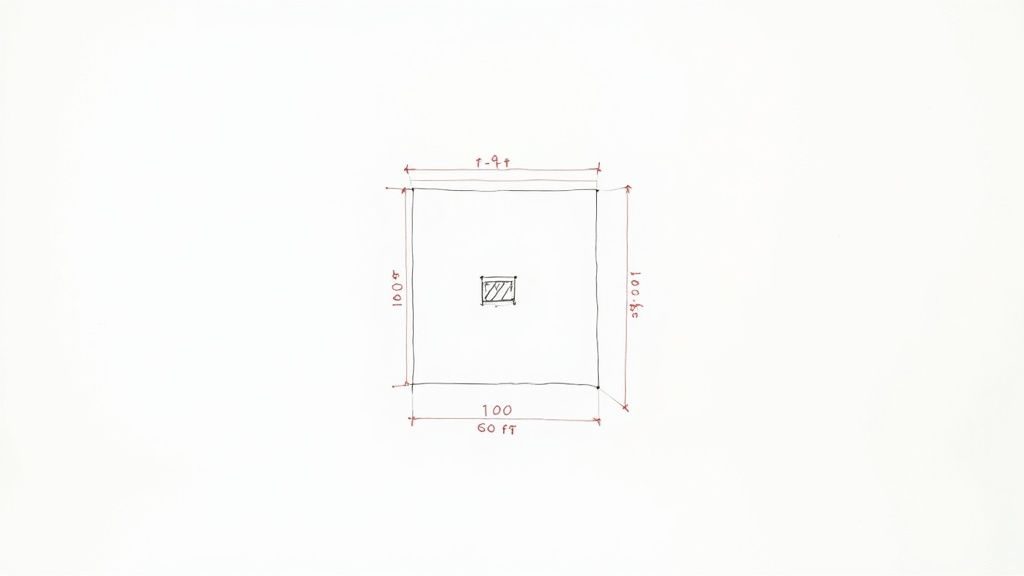
Think of a roofing square as a baker uses a "dozen"—it is a standard unit that simplifies everything. Instead of juggling large numbers like 2,400 or 3,100 square feet, the entire industry speaks in terms of 24 or 31 squares. This terminology streamlines communication from the supplier to the contractor to you, the homeowner.
This measurement is the foundation for estimating how much material is needed, how much labor is involved, and what the final cost will be. If you want to dive deeper into how this standard came to be, you can find more great information on this in-depth roofing industry blog.
To provide a quick reference, here is how a roofing square breaks down.
Roofing Square At a Glance
| Unit of Measurement | Equivalent Area |
|---|---|
| 1 Roofing Square | 100 Square Feet |
| 1 Roofing Square | 11.1 Square Yards |
| 10 Roofing Squares | 1,000 Square Feet |
As you can see, it is a straightforward way to scale up or down depending on the size of your home.
Why This Measurement Matters
Using "squares" as the universal unit is not just about making the math easier; it provides real benefits for both contractors and homeowners. It creates a clear and consistent roadmap for planning any roofing job.
- Simplified Calculations: It is far easier to work with 22 squares than 2,200 square feet. This precision reduces errors and makes quotes easier to understand.
- Accurate Material Orders: Shingles, underlayment, and other supplies are typically packaged and sold based on their coverage per square, which helps ensure you purchase exactly what you need.
- Transparent Cost Estimates: When a roofer breaks down a quote by the square, you get a much clearer picture of how much you are paying for materials versus labor.
Once you grasp this core concept, you are in a much better position to confidently navigate your roofing project from the initial bid to the final nail.
How to Calculate Your Roof’s Square Footage
Before you can discuss "roofing squares," you need to determine your roof's total square footage. The easiest way to get a solid baseline is by measuring the footprint of your house from the ground. Think of this as the foundation for all your other calculations.
It is a fairly straightforward process. First, grab a tape measure and find the length and width of your home's exterior. Do not forget to include any overhangs from eaves or gables, as those add to the total roof area. If you find yourself juggling different units, a good feet to inches conversion tool can be a real lifesaver.
Getting this number right has become even more important as homes have grown larger. Over the past 20 years, the median size of new single-family homes in the U.S. has increased by about 10%, from 2,057 to 2,273 square feet.
A Simple Calculation Example
Let's walk through an example with a basic rectangular home to see how it works. Assume your house is 50 feet long and 30 feet wide.
- Length: 50 feet
- Width: 30 feet
- Calculation: 50 ft x 30 ft = 1,500 square feet
This 1,500 square feet is the flat footprint of your roof. We have not yet accounted for the roof's slope, or "pitch," but this is the essential first step.
This ground-level measurement is your most important starting point. It provides a reliable base area that removes guesswork before you move on to more complex adjustments like roof steepness and material waste.
With this number in hand, you have something concrete to work with. It is the key to understanding how many roofing squares you will ultimately need. This simple calculation allows you to have more productive conversations with roofing contractors and gives you a much better handle on the scope of your project right from the start.
From Square Footage to Roofing Squares
Once you have your roof's total square footage, it is time to translate that number into the language roofers use. Thankfully, the conversion is very simple: just divide your total square footage by 100. This gives you the number of roofing squares.
Let's stick with our example of a home with a 1,500 square foot roof. The math could not be easier.
Calculation: 1,500 square feet ÷ 100 = 15 roofing squares
This simple division is a significant step. It takes a large, abstract number and turns it into a manageable unit that contractors use for ordering materials and building an estimate.
Why a Flat Estimate Isn't Enough
Of course, a real roof is rarely a perfect, flat rectangle. To get from a ballpark guess to a truly accurate estimate, you must account for two critical factors: roof pitch and the waste factor.
The pitch, or steepness, of your roof dramatically changes its actual surface area. Consider a steep A-frame roof versus one that is nearly flat—even if they cover the same ground footprint, the A-frame has significantly more surface area that needs shingles.
On top of that, every roofing job involves cutting materials to fit around vents, chimneys, and valleys. This process always creates leftover material, or waste. Professionals account for this by adding a "waste factor," typically an extra 10-15% of material, to ensure they do not run short in the middle of the job.
Factoring in pitch and waste is what separates a rough guess from a reliable plan. For a more personalized estimate that considers these details, you can experiment with our detailed roof cost calculator to see how different variables affect your project.
Factoring in Roof Pitch and Material Waste
A flat, ground-level measurement gives you a great starting point, but roofs are rarely simple, flat surfaces. To get from a rough guess to a realistic material order, you must account for two things every professional considers: the roof's pitch and the unavoidable waste from cuts.
Getting these adjustments right is what separates a smooth project from one plagued by last-minute material runs and delays.
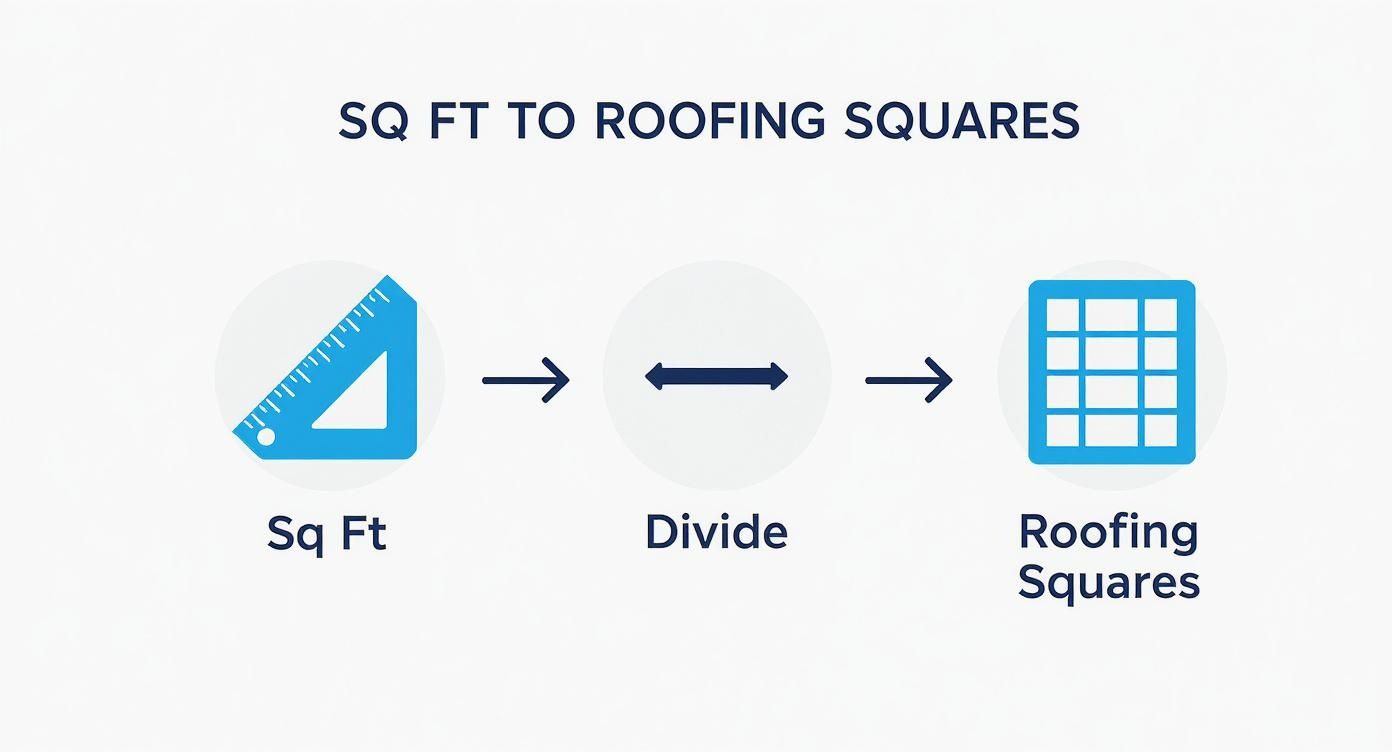
This is the core calculation we use in the industry. It is all about taking a large, sometimes complex area and breaking it down into a standard, manageable unit.
Understanding Roof Pitch Multipliers
The steepness of your roof, known as its pitch, dramatically changes its actual surface area. Picture two houses that both have a 1,500 square foot footprint. One has a nearly flat roof, while the other is a steep A-frame. That A-frame will require significantly more shingles because its surface area is much larger.
This is where a roof pitch multiplier comes in. It is a specific number you multiply your flat square footage by to find the true, shingle-able area.
A steeper pitch means a larger surface area, and failing to account for it is one of the most common—and costly—estimating mistakes.
For example, a gentle 4/12 pitch (the roof rises 4 inches for every 12 inches it runs horizontally) might only need a multiplier of 1.06. But a steep 12/12 pitch requires a multiplier of 1.41. That seemingly small number makes a huge difference in how many squares you will end up needing.
To make this easier, here are the standard multipliers for common roof pitches you will see around Western Washington.
Common Roof Pitch Multipliers
This table shows the multiplier used to convert your roof's flat footprint into its actual surface area based on its pitch. Find your roof's pitch on the left, then multiply your flat square footage by the number on the right.
| Roof Pitch (Rise/Run) | Multiplier |
|---|---|
| 3/12 | 1.03 |
| 4/12 | 1.06 |
| 5/12 | 1.08 |
| 6/12 | 1.12 |
| 8/12 | 1.20 |
| 10/12 | 1.30 |
| 12/12 | 1.41 |
Using the correct multiplier is the key to an accurate material estimate, ensuring you do not come up short halfway through the job.
Why You Must Account for Material Waste
The second critical adjustment is the waste factor. No roofing job uses every single scrap of material perfectly. Shingles have to be cut to fit snugly along valleys, hips, and ridges. They are trimmed around vents, skylights, and chimneys. All those cuts create unusable pieces.
To compensate for this, professionals always add a waste factor to their order, usually between 10% and 15%.
- For a simple, straightforward gable roof, 10% is often sufficient.
- For a more complex roof with multiple dormers, valleys, and angles, that number gets closer to 15%, and sometimes even more.
As you can see in these roofing industry statistics, these details directly impact material and labor costs. Ordering this extra material from the start is simply smart planning. It prevents expensive delays and ensures your crew has what they need to finish the job correctly.
How Many Shingle Bundles Per Roofing Square
https://www.youtube.com/embed/H517K_fVw90
Once you have calculated your adjusted number of roofing squares, you are ready for the final step: turning that area measurement into an actual material list. This is where the concept of a roofing square connects directly to the bundles of shingles you will need to buy.
The most important thing to remember is that not all shingles are the same. The number of bundles needed to cover one 100-square-foot square depends completely on the specific type and style of shingle you have chosen for your home.
Common Shingle Types and Bundle Counts
Fortunately, for most standard roofing projects, the math is quite consistent. The two most common types of shingles have reliable coverage rates that make estimating simple.
- Standard 3-Tab Shingles: These classic, budget-friendly shingles almost always require 3 bundles to cover one roofing square.
- Architectural (Laminated) Shingles: As the most popular choice for modern homes, these also typically require 3 bundles per square.
However, if you are considering a more robust or high-end option, be prepared for a different calculation. Premium, luxury, or specialty designer shingles are often much thicker and heavier, which means a single bundle covers less area. For these, you might need 4 or even 5 bundles to finish just one square.
Always check the manufacturer's specifications printed directly on the shingle packaging. This is the only way to know for sure what the exact coverage is per bundle, ensuring you do not over- or under-buy for your project.
Understanding the differences between these materials is critical for accurate budgeting. For a more detailed breakdown, you can take a closer look at asphalt shingles and see how their construction impacts coverage. By matching your calculated squares to the right bundle count, you can build your final material list with confidence and get your project moving.
Special Considerations for Western Washington Roofing
Generic roofing advice from a big-box store or a national blog does not suffice here in the Pacific Northwest. Calculating a roofing square is the easy part—it is our local conditions that demand a smarter approach to keep your home protected.
Many of our homes in Western Washington, from classic Craftsman bungalows to A-frame mountain cabins, have steep roof pitches. A steeper roof has a much larger surface area than its simple footprint on the ground, which means you will need more squares and more materials than you might think. Add a few dormers and valleys, and that material waste factor can easily jump to 15%.
Protecting Your Roof from Our Climate
It is no secret that our damp, temperate climate is the perfect breeding ground for moss and algae. If left unchecked, they can trap moisture against your shingles and drastically shorten your roof's lifespan.
To combat this, we often recommend shingles infused with copper granules. These specialized shingles slowly release copper ions every time it rains, which naturally prevents moss and algae from taking hold. It is a simple, effective way to keep your roof cleaner and healthier for years to come.
Accounting for these local factors—steep pitches, complex designs, and persistent moisture—is non-negotiable for a roof that is built to last. The unique difficulties of roofing in Seattle and the surrounding areas require expertise that goes well beyond standard calculations.
By choosing the right materials and accurately planning for our region's distinct architectural styles, you are not just getting a new roof; you are getting a durable shield designed specifically for your home.
Common Questions About Roofing Squares
Now that you have the basics down, let's review a few common questions homeowners ask us. Think of this as a quick-reference guide to help you feel even more confident when planning your project.
How Many Bundles Are in a Roofing Square?
This is an excellent question, and the answer truly depends on the shingle you choose. For standard 3-tab asphalt shingles, you can almost always count on 3 bundles per square.
Most of the heavier architectural shingles also come 3 bundles to a square, but you should always double-check the manufacturer's specifications. Some premium or specialty styles are thicker and might take 4 or even more bundles to cover that same 100-square-foot area.
Can I Measure My Roof with Google Maps?
Using satellite images is a clever technique for getting a general idea of your roof's footprint, but it is not reliable for ordering materials. These tools simply cannot see your roof's pitch, and that angle is crucial for determining the true surface area.
When it comes to getting an accurate measurement, nothing beats putting boots on the roof or obtaining a professional aerial measurement report.
One of the biggest mistakes we see is homeowners ordering materials based on their home's interior square footage or a flat satellite view. These methods completely miss the roof's pitch and overhangs, almost always leading to a material shortage halfway through the job.
Does a Square Include Other Materials?
No. A roofing square is strictly a measurement of area—that 100-square-foot patch of roof. While you will certainly use that number to calculate how much underlayment, starter shingles, or ice and water shield you need, the term "square" itself only refers to the surface area.
Understanding these details will help you plan your roofing project with much greater accuracy. For a professional, on-site assessment that accounts for every variable, you can trust the experts at Four Seasons Roofing. Schedule your free, no-obligation inspection today.