
If a roof sits under tall evergreens in Redmond, Sammamish, or other shady parts of Western Washington, moss usually isn’t a surprise. It starts as a soft green patch, then spreads along damp roof sections and leaves homeowners wondering whether it’s only ugly or a sign of bigger roof trouble.
That worry makes sense. Moss often shows up long before a leak is obvious inside the home. By the time ceiling stains appear, the roof may already have trapped moisture, lost granules, or worn down faster than expected.
Many homeowners start searching for moss resistant shingles hoping there’s a shingle that stops moss for good. There are helpful products in this category, but the honest answer is a little more nuanced. The right shingle can slow biological growth and keep a roof looking cleaner longer. It still needs the right installation, roof design, and maintenance to perform well in Western Washington weather.
Your Guide to a Moss-Free Roof in Western Washington
A lot of homeowners around Seattle run into the same pattern. One side of the roof gets less sun, branches hang over the ridge, and moisture seems to linger for days after a storm. That’s usually where moss starts building first.
For homes near the water in places like Shoreline or Burien, damp air can make roof surfaces stay wet even longer. In older neighborhoods with heavy tree cover, the problem often grows faster because debris collects in valleys and gutters.
Short answer: Moss resistant shingles are usually algae-resistant shingles, not truly moss-proof shingles. They can slow staining and biological growth, but they won’t stop moss by themselves in Western Washington. Homeowners still need shade control, debris removal, and regular roof maintenance to keep growth under control.
That distinction matters because it changes expectations. A homeowner choosing new shingles isn’t buying a magic barrier. The upgrade is better understood as a tool that helps the roof stay cleaner and resist growth longer than basic shingles.
What this means for a homeowner
A practical decision usually comes down to three questions:
- Is the current roof still healthy? If shingles are aging, cracking, or losing granules, cleaning alone may not be enough.
- Is the roof constantly shaded? Heavy shade and trapped debris can overwhelm even better shingle products.
- Is the goal prevention or correction? New shingles can help slow future growth. Existing moss may still need cleaning or removal first.
For most homeowners in Western Washington, the smartest approach is combining the right roofing material with realistic upkeep. That’s how confidence replaces guesswork.
What Are Moss Resistant Shingles Really?
The term moss resistant shingles sounds simple, but it causes a lot of confusion. In the roofing world, these products are usually sold as algae-resistant, not fully moss-proof.
That’s because manufacturers generally focus their warranties on blue-green algae discoloration, which is the black streaking many homeowners notice first. The Asphalt Roofing Manufacturers Association explains that algae-resistant shingles are designed to inhibit algae growth for extended periods, and major shingle lines often offer limited algae coverage for the first 10 or 15 years, depending on the product.
How the shingles work
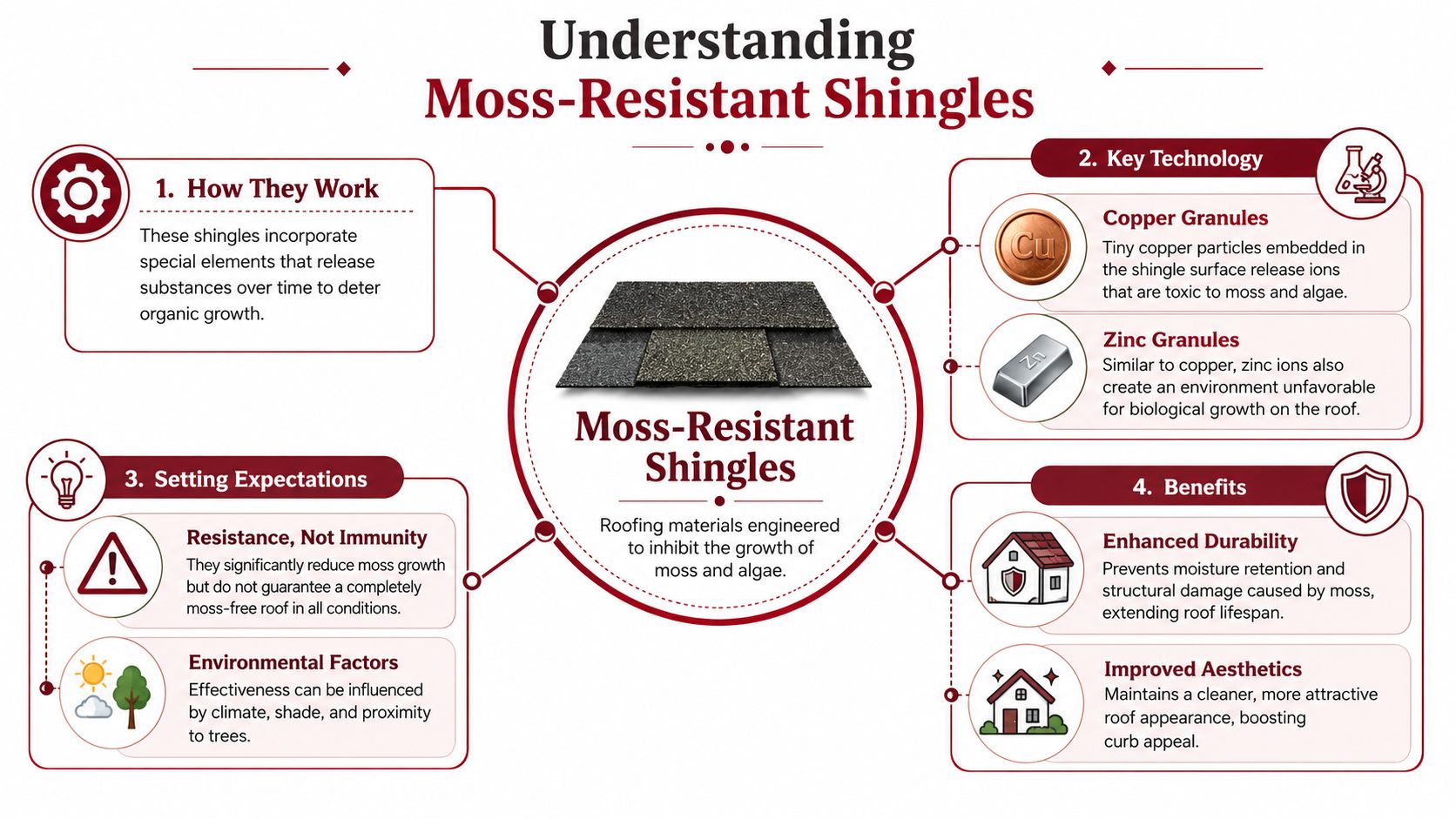
These shingles usually contain small amounts of copper or zinc blended into the surface granules. When rain moves across the roof, those materials release ions that make the surface less friendly to biological growth.
In plain language, they help the roof resist the conditions that allow dark streaks and some organic buildup to take hold. That can also help slow moss, because moss prefers a damp, undisturbed surface.
Why homeowners get mixed messages
The phrase “moss resistant” is often used in everyday conversation because moss is what homeowners see. But the actual roofing language is more cautious.
A few key points help clear that up:
- Resistance isn’t the same as prevention. These shingles can slow growth, but they don’t guarantee a permanently moss-free roof.
- Warranties focus on staining. The main promise is usually about algae discoloration, not moss elimination.
- Wet conditions still matter. Shade, debris, and standing moisture still create the kind of roof surface moss likes.
A homeowner in Western Washington should think of these shingles as a head start, not a finish line.
Why this still matters
Even though no true anti-moss shingle exists, this technology isn’t new or untested. Copper- and zinc-infused granules have been used for several decades as the roofing industry’s response to staining and organic growth in humid climates, as noted by the Asphalt Roofing Manufacturers Association in the source above.
For a homeowner, the takeaway is simple. These shingles are worth considering, especially during a roof replacement. They just work best when paired with the conditions that help any roof stay dry and clear.
How Effective Are They in Our Wet Climate?
Western Washington gives roofs a hard job. Long rainy stretches, cool temperatures, and tree cover can keep some roof sections damp for long periods. That’s exactly why homeowners ask whether moss resistant shingles really make a difference here.
They do help, but the strongest performance claim in this category is still about algae staining. For example, top-tier shingles with built-in algae protection can carry limited warranties against blue-green algae discoloration for 25 years or 30 years, depending on the product line, according to GAF’s StainGuard Plus warranty information.
What those warranties actually mean
A longer algae warranty tells a homeowner that manufacturers have confidence in the shingle’s ability to resist black streaking. It does not mean the roof is guaranteed to stay free of moss through its whole life.
That difference is important in places like Seattle, Bellevue, and the eastside foothill communities where roofs often sit under firs, cedars, and maples. On those homes, the roof may still need attention if moisture keeps collecting.
Real-world expectations in Western Washington
A good way to think about performance is this:
- Best result: cleaner-looking roof surfaces and slower biological growth
- Still possible: moss returning on the shadiest or dampest sections
- Most realistic outcome: less frequent trouble than standard shingles, but not zero maintenance
Homeowners who want a practical plan can pair shingle choice with shade management and routine upkeep. A useful next step is reviewing how to prevent moss on roof surfaces in Western Washington, especially for homes surrounded by trees.
The better the roof can dry out between storms, the more helpful moss resistant shingles become.
For many homes in this region, that makes these shingles a strong upgrade. They’re especially useful when a roof replacement is already needed and the homeowner wants a product that fits local weather better than a standard shingle.
Proper Installation and Long-Term Roof Maintenance
Choosing the right shingle matters, but installation and upkeep matter just as much. If a roof is installed poorly, even a better shingle can’t deliver the protection a homeowner expects.
Professional installation helps make sure the roof has the right layout, fastening, ventilation details, and manufacturer-approved methods. It also helps protect warranty eligibility. That’s one reason homeowners shouldn’t treat specialized shingles as a simple material swap.

Why maintenance still matters
Roofing guidance for humid climates shows why upkeep can’t be skipped. On unprotected roofs in coastal, humid environments, black streaking from algae can appear in as little as 3 years, according to Malarkey Roofing’s guidance on managing moss and algae.
That same guidance points back to the basics. Clearing gutters, trimming overhanging branches, and removing debris are still some of the most effective ways to slow moss and algae because they reduce the moisture and shade those organisms need.
Safe steps homeowners can take
Most homeowners can help their roof from the ground or from other safe access points around the home. The goal is to reduce damp, shady conditions without damaging the shingles.
- Keep gutters clear. Overflowing gutters can hold water where the roof edge should be drying out.
- Trim branches back. More sunlight and airflow usually mean less moss pressure.
- Watch for debris buildup. Needles and leaves often collect in valleys and behind roof features.
- Check after stormy stretches. Wet weather can hide buildup until it becomes obvious.
What to avoid
Some cleaning methods do more harm than good.
- Avoid pressure washing. High pressure can strip protective granules from asphalt shingles.
- Don’t walk on a mossy roof. Moss makes surfaces slippery, and wet shingles are unsafe.
- Don’t scrape aggressively. Rough removal can shorten roof life, especially on older shingles.
For homeowners comparing cleaning methods, this guide on soft washing roof cleaning explained offers a helpful overview of lower-pressure cleaning approaches and why gentler methods are usually safer for roof surfaces.
Practical rule: If the roof is steep, high, heavily covered in moss, or already aging, it’s time to call a roofing professional instead of trying to clean it alone.
A professional roof inspection can help confirm whether the roof only needs maintenance or whether underlying wear has already started.
Signs You Need a Roof Replacement Instead of Cleaning
A lot of homeowners hope a roof can be cleaned and get a few more good years. Sometimes that’s true. Sometimes cleaning only makes a failing roof easier to see.
The safest way to judge is from the ground, around the attic, and from what shows up inside the home.
Signs the roof may only need professional cleaning
If the roof still looks structurally sound, moss may be more of a surface problem than a replacement issue.
- Light, patchy moss growth. Small areas of buildup on an otherwise solid-looking roof can often be addressed with professional cleaning and maintenance.
- Shingles still lying flat. If the roof lines look even and the shingles don’t appear curled or cracked, the material may still have life left.
- No interior water signs. If ceilings, attic areas, and walls aren’t showing moisture issues, the roof may still be functioning well.
Signs a roof replacement is more likely
Some warning signs suggest the roof material itself is near the end of its useful life.
- Curling, cracking, or bald-looking shingles. These signs usually mean the surface is wearing out, not just dirty.
- Granules collecting in gutters. If the protective top layer is shedding heavily, the roof may not respond well to cleaning.
- Ceiling stains or attic moisture. Water marks indoors often mean the issue has moved beyond surface growth.
- Widespread moss in shingle gaps. Thick growth tucked into shingle edges can point to long-term moisture exposure and material wear.
A homeowner who’s unsure can compare these signs with other common signs you need new roof materials. That can prevent spending money on cleaning when replacement would be the safer long-term decision.
Cleaning makes sense for a roof that’s still healthy. It doesn’t make sense for a roof that’s already failing.
Comparing Roofing Systems for Moss-Prone Homes
For a home that deals with steady shade and moisture, shingles aren’t the only option. Some homeowners planning a roof replacement also consider metal or tile because they want less moss buildup over time.
Each roofing material comes with trade-offs. The right fit depends on budget, roof design, appearance goals, and how much maintenance a homeowner wants to manage.
Roofing options for Western Washington homes
| Roofing Material | Moss Resistance | Typical Lifespan | Upfront Cost |
|---|---|---|---|
| Composition shingles with algae-resistant technology | Good, especially with maintenance | Moderate to long | Lower |
| Metal roofing | Very strong resistance to buildup | Long | Higher |
| Tile roofing | Strong surface resistance, but debris and moisture still matter | Long | Higher |
How to think through the comparison
Composition shingles are often the most practical fit for homeowners who want a balance of appearance, cost, and improved resistance to staining and organic growth. They work well in Western Washington when paired with routine roof maintenance.
Metal roofing usually sheds water and debris more easily, which can make it less welcoming to moss. It may still collect buildup in shaded areas or where debris sits, but many homeowners choose it because it tends to dry faster than textured roofing surfaces.
Tile roofing can be durable, but moss can still collect wherever moisture and debris remain. Roof shape, surrounding trees, and maintenance access all play a role.
Which choice fits which home
A simple way to narrow it down:
- Budget-focused homeowner: upgraded composition shingles are often the easiest place to start
- Home with heavy tree cover: metal may be worth a closer look if the structure and budget support it
- Appearance-driven replacement: tile can appeal to some homeowners, but maintenance planning still matters
For homeowners weighing broader material trade-offs, this guide to metal vs shingle roof pros and cons can help frame the decision around home style, maintenance, and long-term priorities.
The main point is that no roof becomes maintenance-free just because the material changes. In this climate, every roof benefits from airflow, sunlight, and regular care.
Protect Your Home with Four Seasons Roofing
When moss keeps coming back, homeowners usually need more than a product recommendation. They need to know whether the roof should be cleaned, repaired, or replaced.
At Four Seasons Roofing, the certified team handles this type of issue every day across the Seattle area, from shaded suburban neighborhoods to damp homes closer to the water. Their work includes roof inspections, roof replacement, major repairs, and guidance on composition shingles, metal roofing, tile, and low-slope systems.
What homeowners can expect
A helpful process usually starts with a roof inspection. That gives the homeowner a clearer answer on what's happening now, not just what might be happening.
From there, the next steps may include:
- Cleaning guidance if the roof is still in sound condition
- Repair recommendations if a smaller issue is allowing moisture in
- Replacement planning if the shingles are worn out or moss has become a symptom of deeper roof aging
Homeowners in Western Washington often want two things. An honest recommendation and a roof that's built to hold up in wet weather. Clear communication, proper installation, and warranty support help make that decision easier.
Frequently Asked Questions About Roof Moss and Shingles
Are moss resistant shingles actually moss-proof?
No. Most products homeowners call moss resistant shingles are really designed as algae-resistant shingles. They can slow biological growth, but they don't make a roof permanently immune to moss in wet, shaded conditions.
Do moss resistant shingles help in Western Washington?
Yes, they can help. They're especially useful for slowing black streaking and reducing how quickly growth starts, but they work best when the roof also gets regular maintenance and enough airflow and light.
Can a homeowner power wash moss off a roof?
That's usually not a good idea for asphalt shingles. High pressure can remove protective granules and shorten roof life, so gentler cleaning methods are generally the safer choice.
Will roof moss cause leaks?
It can contribute to leak risk. Moss holds moisture against the roof surface, and thicker growth can work into shingle edges and make wear worse over time. If a homeowner is noticing moss along with ceiling stains or attic moisture, a professional roof inspection can help confirm what's going on.
How often does a moss-prone roof need attention?
That depends on the amount of shade, moisture, and debris around the home. In wetter, tree-covered areas, roofs often need regular monitoring so buildup can be addressed before it becomes thick and damaging.
Is cleaning always better than replacing the roof?
No. Cleaning is a smart move when the roof is still structurally sound. If shingles are curling, cracking, losing granules, or allowing water into the home, replacement is often the more cost-effective decision.
If moss keeps showing up and there's uncertainty about whether the roof needs cleaning, repair, or replacement, Four Seasons Roofing can help with a professional inspection and practical guidance on moss resistant shingles for Western Washington homes.