
A lot of homeowners start looking into roof payment plans at the same moment they realize the problem won’t wait.
It might be the drip that shows up over the hallway after a hard Seattle rain. It might be dark streaks near the ceiling. If your home sits under tall trees in places like Sammamish or Redmond, it might be the moss you’ve watched spread a little more each season.
Homeowners typically don’t budget for a roof the way they budget for a car or kitchen remodel. Roof work often arrives as an unwelcome surprise. That’s why payment plans matter so much. They give homeowners a way to protect the house now, instead of waiting and hoping the leak stays small.
Why roof payment plans matter for homeowners
A roof problem usually starts as a home problem, not a roofing problem.
You notice a stain on the ceiling. The attic smells damp. A bedroom stays colder than the rest of the house. Homes near the water in places like Shoreline or Burien often see faster wear from salt air, and older roofs in those areas can go from “probably okay” to “needs attention” faster than expected.
When the estimate comes in, the number can feel heavy. That’s where roof payment plans change the conversation.
Instead of asking, “Can we pay all of this today?” you get to ask, “Can this fit into our monthly budget?” Contractors that offer financing see a 45% increase in project close rates, and a $15,000 roof often lands around $175 to $275 per month under common terms, according to BuyFin’s roofing financing overview.
Why that shift matters at home
For a homeowner, this isn’t just about convenience.
It’s about acting before a small leak turns into damaged insulation, ruined drywall, or mold concerns. It’s also about not draining savings that might already be set aside for emergencies, school costs, or car repairs.
A payment plan can also open the door to better choices. Instead of choosing the cheapest option just to get the project done, some homeowners can consider longer-lasting materials or more complete repairs. If you want to understand the practical value of that investment, this look at the benefits of a new roof is a useful next read.
Practical rule: If the roof issue is active, affordability matters, but timing matters too. Waiting often gives water more time to spread.
Common situations where payment plans help
- Leak stress: You need work soon, but cash on hand is limited.
- Storm damage gaps: Insurance may help, but your deductible or uncovered items still leave a bill.
- Older home upgrades: You’re trying to protect a house you plan to stay in for years.
- Budget balance: You want predictable monthly payments instead of one large hit to savings.
For many Puget Sound homeowners, roof payment plans aren’t a luxury. They’re the thing that makes a necessary project possible.
Understanding roof payment plans
A roof payment plan lets you pay for a roof in parts instead of all at once. The roof gets installed now, and you repay the cost over time through monthly payments.
For many homeowners, that sounds simple until the estimate turns into a financing offer with unfamiliar terms. A plan that looks affordable in the first five minutes can cost much more over seven, ten, or twelve years.
That difference matters in Western Washington. A homeowner in Tacoma with an older asphalt roof may want the lowest payment just to stop an active leak. A homeowner in Bellevue planning to stay put for 20 years may care more about total cost, because a longer loan can add thousands over time. The monthly payment is only one part of the decision.
What a roof payment plan usually includes
In many cases, the roofing company is not lending you the money directly. The funds often come from a lending partner, bank, credit union, financing platform, or manufacturer-backed program connected to the contractor. You approve the work, the roof gets done, and then you make scheduled payments to the financing company.
The setup works a lot like buying a car with financing. You are not only choosing the thing you need. You are also choosing how long you want to pay for it and what that choice will cost over time.
The terms that affect what you really pay
A few words show up on almost every offer:
- APR: the yearly cost of borrowing
- Loan term: how long you have to repay the balance
- Down payment: the amount you pay up front
- Promotional financing: a special offer that may reduce interest for a set period if you qualify
If you have compared solar, windows, or HVAC financing before, a guide to general financing options for homeowners can give useful background on how these structures work across home projects.
Why the term length matters so much
Loan term is where many homeowners get tripped up.
A longer term usually lowers the monthly payment. That can be helpful if your budget is tight after a storm, an insurance deductible, or another big home expense. But a lower payment often means paying interest for more years. In plain language, the roof may feel cheaper each month while costing more overall.
A shorter term does the opposite. The payment is higher, but you are done sooner and often pay less in the end.
Here is the simplest way to look at it. A long-term plan can work like stretching a ferry fare into many small tickets. Each ticket feels manageable, but the total spent can end up higher than paying the full fare sooner.
A practical way to evaluate an offer
Before you focus on the monthly number, ask four questions:
- How much will I pay in total by the end of the loan?
- How long will I still be paying for this roof?
- Will this payment still feel comfortable during slower months or surprise expenses?
- Am I choosing a term that fits my budget, or just the lowest number on the page?
That last question matters a lot in the Puget Sound area, where roofing projects often happen alongside other home costs like drainage fixes, insulation work, or skylight replacement. Chasing the smallest monthly payment can make sense in an emergency. It is not always the cheapest ownership decision.
If you want to compare financing offers against realistic project pricing first, this guide on how much a new roof costs helps you estimate the size of the project before you review terms.
A good roof payment plan should match two things at once. It should fit your monthly budget now, and it should still make sense when you add up the full cost later.
Comparing roof payment plans options
A roof financing offer can look friendly on paper and still cost far more than expected.
That happens all the time when a homeowner in Tacoma, Kent, or Bellingham zeroes in on the monthly payment and skips the bigger question: how long will this roof still be on the bill after the work is done? In Western Washington, that choice matters because roof projects often show up at the same time as gutter replacement, ventilation fixes, plywood repairs, or moss-related cleanup.
The goal is not just to find a payment plan you can squeeze into this month’s budget. The goal is to choose a plan that fits the project, the timeline, and the total amount you will repay.
Financing option comparison
| Option | How it usually works | Payment pattern | Best fit | Main tradeoff |
|---|---|---|---|---|
| Contractor financing | Offered through the roofing company’s lending partners during the estimate and approval process | Often fixed monthly payments over a set term | Homeowners who want a fast decision and one place to handle the project | Convenience can come with a longer term and higher total cost |
| Personal loan | Borrowed from a bank, credit union, or online lender without using home equity | Usually fixed payments with a fixed payoff date | Homeowners who want predictable payments and want to keep the loan separate from the house | Rates may be higher than equity-based options |
| HELOC | Borrows against home equity through a revolving credit line | Payments can change depending on rate and amount used | Homeowners with available equity who want flexibility | Variable rates can make future payments harder to predict |
| Credit card | Uses available revolving credit, sometimes with a temporary promotional rate | Minimum payments can look low at first | Small repairs or short-term gaps, not full replacements | Carrying a large balance can get expensive quickly |
| PACE | Property-related repayment program where available and eligible | Paid through a property-based structure rather than a standard loan | Homeowners exploring specific improvement funding programs | Availability and rules vary by location and property |
| Manufacturer promotion | Promotional financing tied to certain roofing systems or contractor programs | Low or zero interest for a limited period in some cases | Homeowners with strong credit and a clear payoff plan | The cost can jump if the balance is still there after the promo period |
How these options differ in real life
Contractor financing is usually the quickest path. You review the estimate, fill out an application, and may get an answer fast enough to keep an urgent project moving. For a leaking roof in November, speed has value.
But speed is only one part of the decision.
A longer contractor loan often works like spreading a ferry pass across many extra months. The payment gets easier to carry, but the full trip costs more. A homeowner in Puyallup might feel relieved seeing a lower monthly number, then realize years later they paid much more for the same roof than they would have on a shorter term.
Personal loans are simpler to compare because they usually come with fixed terms and fixed payments. If you like clean numbers and a set payoff date, this option can be easier to reason through. The catch is timing. If rain is getting into the attic, waiting on a lender’s process may not line up with the urgency of the repair.
HELOCs can make sense for homeowners with strong equity, especially if they are already planning other house work. A line of credit gives flexibility, which helps when a roof replacement turns up added plywood damage after tear-off. If you are weighing that route, this guide on using home equity to pay for improvements can help you look at the broader financial impact.
Credit cards and promotional offers need extra caution. The starting payment can look light, which is exactly why people get drawn in. For a small repair, that may be fine. For a full roof in the Puget Sound area, a card balance or expired promo rate can turn a manageable project into a long, expensive payoff.
A better way to compare offers
Use the same roof project and run each option through four filters:
- How quickly can the money be available?
- Will the payment stay predictable, or can it change?
- How much will I repay by the end?
- Will I still be paying for this roof long after I expected to be done?
That last question is where many homeowners save or lose real money.
A 15-year payment plan may look more comfortable than a 7-year plan. If the longer term keeps you from draining savings during an emergency, that can be a smart choice. If you choose it only because the monthly number looks smaller, you may end up paying for convenience long after the roof has stopped feeling new.
Before you commit, compare the financing terms right alongside the materials, scope, and workmanship details in each proposal. This guide to comparing roofing estimates side by side helps with that part.
The best roof payment plan is the one that solves the current problem without quietly becoming the most expensive part of the project.
Eligibility and credit considerations
A lot of homeowners ask the same question first.
“Will I even qualify?”
The honest answer is that qualification depends on the lender, the type of financing, and your overall financial picture. Credit score matters, but it usually isn’t the only thing under review.
What lenders usually look at
Many lenders list 575 as a minimum credit score, but Washington-specific approval rates and debt-to-income expectations are rarely made public, according to this overview of roof financing qualification questions.
That lack of local detail is frustrating for homeowners. You can know the minimum score and still have no clear idea whether your application is likely to go through.
In practical terms, lenders often review:
- Credit history: Not just your score, but whether you’ve handled payments consistently.
- Income: They want to see that the monthly payment fits your budget.
- Existing debt: Car loans, credit cards, and other obligations can affect approval.
- Property details: Equity and ownership can matter, especially for HELOC-style products.
What this means if your credit is fair
If your credit is fair, don’t assume you’re automatically out.
Some homeowners still qualify for contractor-arranged financing or other loan products, but the terms may be less favorable. That could mean a higher rate, a shorter repayment window, or a lower approval amount than expected.
Homeowners often get tripped up by these aspects. They focus on whether they can get approved at all, but they don’t spend enough time asking whether the approved terms are workable.
Questions worth asking before you apply
It helps to go into the process prepared.
- What’s the monthly payment? Make sure it fits your real budget, not your best-case month.
- Is the rate fixed or variable? A fixed payment is easier for many households to plan around.
- Is there a promotional period? If so, what changes after it ends?
- Are there penalties or fees? You want the full picture before signing.
- Does this financing require home equity? That matters if you’ve recently bought the home or refinanced.
Ways to improve your odds
You may not be able to change your credit overnight, but you can still make the process smoother.
- Check your credit report first. Errors happen, and fixing one can help.
- Gather income documents early. Missing paperwork slows things down.
- Reduce confusion on the application. Use consistent income and address information.
- Ask about multiple options. One lender may decline while another may approve.
If your roof is urgent and your credit is less than ideal, ask about more than one financing path before you assume the answer is no.
For homeowners in King, Snohomish, and Pierce counties, the biggest challenge usually isn’t a total lack of options. It’s sorting through unclear qualification rules without much local transparency. A careful review of the terms matters just as much as the approval itself.
Cost examples and long term ownership costs
Many homeowners make a costly mistake when evaluating payment plans.
They choose the lowest monthly payment, feel relieved, and only later realize how much extra they’ll pay over the full life of the loan. Roof payment plans can be very helpful, but the term length changes the true cost in a big way.
Landmark Roofing points out a major gap in roof financing content. Homeowners financing an $18,000 roof over 36 months versus 180 months can end up paying very different total interest amounts, and that long-term difference can reshape the total ownership cost, as discussed in its article on roof financing options and cost comparisons.
Here’s a visual example.

What the shorter term does
On the 36-month example in the infographic:
- Loan term: 36 months
- Estimated monthly payment: $563.85
- Total principal plus interest paid: $20,298.60
- Total interest paid: $2,298.60
That monthly payment is much harder on a household budget.
But the total interest stays far lower.
What the longer term does
On the 180-month example in the infographic:
- Loan term: 180 months
- Estimated monthly payment: $172.04
- Total principal plus interest paid: $30,967.20
- Total interest paid: $12,967.20
That’s why a low monthly payment can be misleading. It may ease pressure now, but it can increase the full cost of the roof by a lot over time.
How to think about the tradeoff
This doesn’t mean longer terms are always wrong.
A longer term may be the only practical way to stop an active leak without draining emergency savings. If the roof is failing, solving the water problem now can still be the smarter move than waiting.
The better question is this: are you choosing the longer term because it fits your situation, or because the monthly number looked comforting in isolation?
A simple decision framework
Use these checkpoints when comparing offers:
- Urgency first: If the roof is letting water in, delaying can create bigger repair costs inside the home.
- Monthly budget next: Pick a payment you can handle consistently.
- Total cost after that: Compare what you’ll pay over the full term, not just in month one.
- Time in the home: If you expect to stay for years, the long-term cost matters even more.
A roof loan isn’t just a payment plan. It becomes part of your home’s ownership cost.
Material choice can change the picture too
Some homeowners in Western Washington use financing to move from a basic replacement to a longer-lasting material.
Owens Corning’s financing overview notes that standing seam metal can offer a 40-60 year lifespan versus 20-30 years for composition shingles in industry-standard ranges discussed there, which affects how some homeowners think about value over time. If the longer-lasting material better matches how long you plan to stay in the home, a higher project cost may still make sense.
Insurance can shape the math too. Kin explains that a $15,000 roof replacement on a 12-year-old composition roof may leave a $7,200 gap after depreciation in the example it gives, which is why some homeowners turn to financing after a claim. It also notes that metal roofs depreciate differently in the scenarios discussed there, which can reduce future out-of-pocket gaps in some cases.
If you want to connect financing decisions to project size, this breakdown of roof replacement cost per square can help you estimate how material choice changes the amount you may need to finance.
How to apply for roof payment plans
Applying for roof payment plans usually feels easier once you know what paperwork to expect.
For most homeowners, the process is less about complicated finance language and more about staying organized. The faster you gather your information, the faster you can compare real offers instead of guessing.
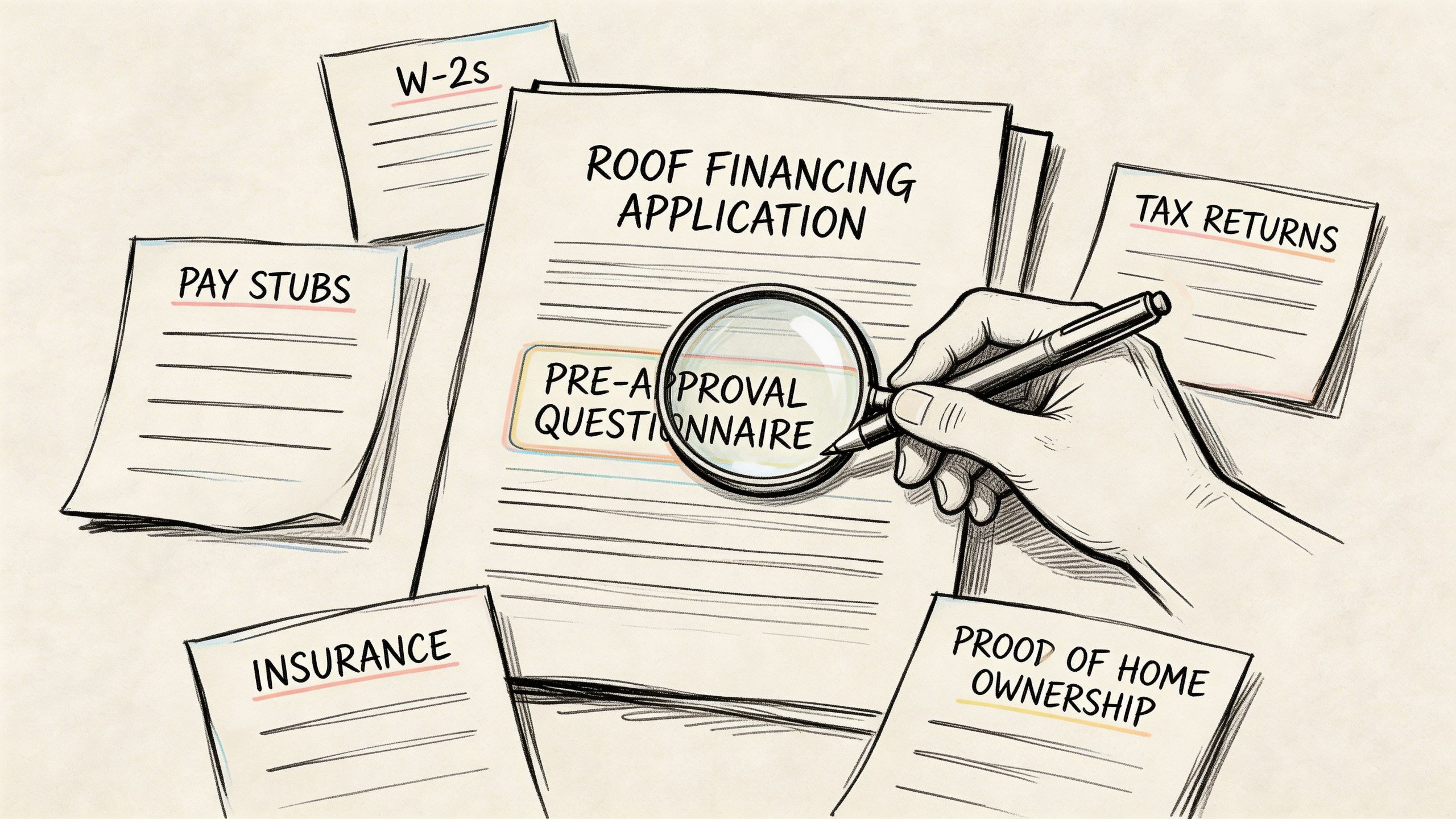
What to gather before you apply
Different lenders ask for different items, but homeowners often need:
- Proof of identity: Driver’s license or another government ID.
- Proof of income: Pay stubs, W-2s, or tax returns.
- Proof of homeownership: Mortgage statement, deed record, or insurance paperwork.
- Project details: Your roofing estimate and scope of work.
- Insurance documents if relevant: Especially if storm damage is part of the story.
Having these ready can save days of back-and-forth.
What the process usually looks like
A typical application flow goes something like this:
- Get a roof estimate. You need to know the likely project amount first.
- Choose the financing path. Contractor financing, bank loan, HELOC, or another option.
- Complete the application. This may be online, by phone, or with help from the contractor.
- Review the offer carefully. Check monthly payment, term, rate, and any promo details.
- Sign only when the numbers make sense. Don’t rush because the roof issue feels stressful.
Timelines homeowners should expect
Not every route moves at the same speed.
Contractor-integrated financing can often move quickly, while bank or credit-union options may take longer. HELOCs can take more time because the lender may review property and equity details more closely.
If your roof is actively leaking, speed may matter almost as much as cost. If the issue is not yet urgent, you may have more room to compare.
How to avoid surprises
This part matters.
- Read the full payment terms: Don’t stop at the monthly number.
- Ask what changes after a promotion: Low intro terms can shift later.
- Check for penalties or fees: Especially if you hope to pay early.
- Confirm project timing: Make sure funding and scheduling line up.
Before signing, ask one plain question: “What will this roof cost me in total if I follow this payment schedule exactly?”
If you’re ready to start with the roof side of the process, request a quote first so you know what amount you’re evaluating. A simple first step is to get a free estimate.
Local roof financing options with Four Seasons Roofing
For homeowners around Puget Sound, local context matters.
Roofing in Western Washington isn’t just about shingles or metal panels. It’s about constant moisture, moss, wind-driven rain, salt air in some neighborhoods, and homes that may sit under heavy tree cover for much of the year. Financing needs often show up in the middle of that reality, when the roof can’t wait but the budget still has limits.
When the roof can’t wait but the budget still has limits, a contractor’s process matters just as much as the financing itself.

A local process homeowners can follow
A clear roofing process helps remove some of the stress from the financial side too.
For example, Four Seasons Roofing has served Western Washington homeowners since 1996 and uses a four-step process of communication, consultation, replacement, and protection. In practical terms, that means the homeowner gets a roof assessment, a clear explanation of the work, project coordination, and warranty-backed follow-through rather than trying to piece everything together alone.
How financing fits into that process
Roof payment plans work best when they’re tied to clear project information.
That means:
- You know what the roof issue is. Leak, age, storm damage, or widespread wear.
- You know the scope. Repair versus replacement, plus material choices.
- You know the budget impact. Monthly payment and overall cost.
- You know the protection level. Warranty details matter when comparing value.
If your home in Seattle, Edmonds, or Bellevue has ongoing leak concerns, or you’ve seen moss and wear build up over several seasons, the financing conversation should happen alongside the roof inspection, not after the fact.
What to ask a local contractor
Even if you already know you want financing, ask these questions before moving forward:
- Can you explain the roof problem in plain language?
- Are there multiple payment options or just one lender?
- What happens if insurance covers part of the project?
- How long is the workmanship coverage?
- Will someone walk me through the paperwork?
Those questions matter because financing shouldn’t feel detached from the actual work on your home.
Good roof financing support means someone helps you connect the money decision to the roof decision.
For many homeowners, that local support is invaluable. Not because financing alone solves the problem, but because it makes it easier to move from worry to a real plan while keeping the project grounded in your home’s actual needs.
FAQs and next steps
Can I refinance a roof payment plan later
Sometimes you can, but it depends on the loan terms and the lender.
If rates change or your credit improves, refinancing may become an option. Before you count on that, check whether your current plan has fees, penalties, or limits on early payoff.
What happens if I move before the roof loan is paid off
That depends on the financing type.
Some loans stay with you personally and need to be paid through the sale or continued after the move. Other financing structures may work differently. This is an important question to ask before signing if you may sell the home soon.
How does insurance work with roof payment plans
Insurance and financing often work together when a claim doesn’t cover the full project.
That can happen if you have a deductible, depreciation, or excluded work. In those cases, financing may help cover the homeowner portion so the project can move ahead without delay.
What should I do next
If you think roof payment plans may apply to your situation, keep it simple.
- Schedule an inspection or estimate. You need to know whether you’re dealing with a repair or a full replacement.
- Ask for the total project cost. Don’t compare financing until you know the exact cost.
- Review at least two payment paths. Monthly payment matters, but so does total cost.
- Match the plan to your timeline. Think about urgency, budget, and how long you expect to stay in the home.
A roof problem is stressful enough. The financial side doesn’t have to stay confusing.
If you’re dealing with leaks, storm damage, or an aging roof in Western Washington, Four Seasons Roofing can help you understand the condition of your roof, review project options, and take the next step with more clarity.