
Tile roof underlayment replacement cost usually falls between $1,000 and $9,000, but for many Seattle-area homes, a practical planning range is about $2 to $5 per square foot, or roughly $4,000 to $10,000+ for a common-sized home. The wide spread comes down to a few big factors, especially the kind of tile on the roof, how steep or complex the roof is, and the labor needed to remove and reset those tiles without causing extra damage.
A lot of homeowners start looking into this after a ceiling stain shows up, a leak appears during a long stretch of Western Washington rain, or a home inspection mentions aging underlayment under an older tile roof. That can feel overwhelming fast, mostly because one bid may look reasonable and another may come in much higher.
The good news is that the numbers make a lot more sense once the job is broken into plain English. For tile roofs, the hidden waterproof layer under the tile is often the part that wears out first, even when the tile itself still has life left. That means the key question usually isn't just "How much does material cost?" It's "How much careful labor does this roof need?"
Tile Roof Underlayment Replacement Cost in Washington
Understanding Your Tile Roof Underlayment Replacement Cost
If a homeowner is hearing that the tile roof may be "fine" but the underlayment needs replacement, that can sound confusing. It helps to think of tile and underlayment as two different layers doing two different jobs. The tile sheds most of the weather. The underlayment is the backup barrier that keeps water from reaching the wood below.
That matters because a tile roof underlayment replacement cost isn't the same thing as a full new tile roof. A cost comparison for tile underlayment and full replacement notes that underlayment-only work commonly lands around $1,000 to $9,000, with a basic installed benchmark of $1.08 to $1.31 per square foot, while full tile roof replacement is far higher at $8.00 to $25.00 per square foot or $8,000 to $23,000 total.
Main takeaway: Underlayment replacement is still a major roofing project, but it usually costs much less than replacing the whole tile roof.
In Puget Sound, the stress often comes from wet weather patterns, moss pressure, and roofs that stay damp longer than homeowners expect. In places like Sammamish and Redmond, tall trees can keep sections of tile shaded for long periods. Near the water in Shoreline or Burien, homes may also see more exterior wear from constant moisture and marine air.
A short answer for worried homeowners
For many homeowners, the most useful starting point is this:
- Smaller or simpler jobs may land closer to the lower end of the general range.
- Average homes with tile reset work often land in the middle.
- Larger, steeper, or more delicate tile roofs can move well past a basic estimate.
The price can look high at first. But once a homeowner understands that much of the work involves carefully removing, stacking, protecting, and reinstalling heavy tile, the quote starts to feel a lot less mysterious.
What Is Roof Underlayment and Why Does It Matter So Much
A lot of Seattle-area homeowners call because the tile still looks fine from the driveway, but there is a stain on a bedroom ceiling or moisture showing up in the attic. That usually points to the layer below the tile, not the tile itself.
Underlayment sits between the roof deck and the tile. It works like the water-shedding layer that keeps the house dry after wind-driven rain gets past the outer surface. On a tile roof, the tile takes the abuse from sun, rain, and debris. The underlayment is often the part doing the day-to-day work of keeping water out.
In Western Washington, that matters even more. We deal with long stretches of damp weather, moss, needles, shade, and roofs that stay wet longer than homeowners expect. A roof does not need a dramatic storm failure to have an underlayment problem. Small amounts of water can work in over time, especially around valleys, flashings, and penetrations.

Why tile roofs can still leak
Tile is long-lasting, but tile by itself is not a sealed roofing system. Water can get under tile during wind-driven rain, from capillary action, or when a tile cracks, slips, or lifts slightly. That is normal enough that the roof is built with underlayment as a secondary water barrier.
Problems usually start in familiar spots:
- Older underlayment that has become brittle, thin, or worn
- Cracked, slipped, or broken tiles that let more water reach the layer below
- Aging flashings around chimneys, skylights, vents, and roof edges
- Hidden moisture entry that stays out of sight until it stains drywall or trim
That is why a tile roof can look respectable from the ground and still be due for major work underneath.
The material choices homeowners usually hear about
Homeowners usually hear three basic categories. Felt is the old standard. It costs less up front, but it generally does not hold up as well as newer products in a damp climate. Synthetic underlayment is lighter, tougher to tear, and common on modern replacement work. Rubberized or self-adhered products are often used in vulnerable areas where extra water protection makes sense.
A cost breakdown for underlayment replacement materials lists common material pricing at about $0.15 to $0.60 per square foot for felt, $0.25 to $0.80 for synthetic, and roughly $0.25 to $1.50 for rubberized asphalt.
Those numbers are useful, but they also cause confusion. Homeowners see a low material price and expect the whole job to be inexpensive. On a tile roof, the underlayment itself is only one piece of the bid. The bigger cost question is how much work it takes to get to that layer and then put the roof back together correctly.
The hidden underlayment often fails before the visible tile does. That is why a roof can look fine from the ground but still need major work.
The Real Factors Driving Your Replacement Cost
The biggest misunderstanding around tile roof underlayment replacement cost is that people assume the material is the expensive part. Usually, it isn't. The costly part is the careful labor around the tile.
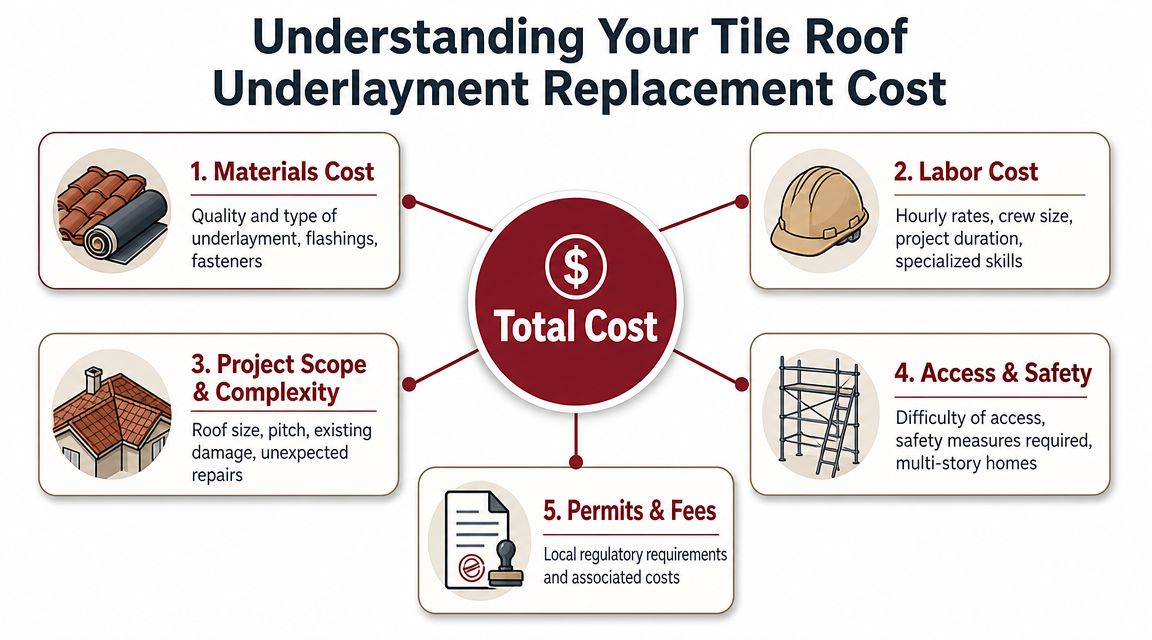
Labor is usually the biggest part
Tile roofs are heavy, brittle, and slow to work on. Crews often need to remove the tiles, sort them, stack them safely, protect the roof deck, install the new underlayment, and then reset the tiles. That takes time and skill.
An Angi guide on roof underlayment replacement costs notes that tile underlayment replacement averages about $4,200, but that the total varies widely with roof size, pitch, and material choice. It also points out the key issue homeowners often miss: tile work is very labor-heavy because the tiles often need to be removed and reinstalled.
For Seattle-area homes, labor can rise quickly when the roof has:
- Steep slopes that require more safety setup
- Multiple valleys and dormers that slow down removal and reset work
- Second-story or hard-to-access sections that make staging harder
- Older or fragile tile that needs extra care to avoid breakage
Materials matter, but they rarely tell the whole story
Underlayment type still affects the quote. Some homeowners prefer the lower upfront cost of felt. Others choose synthetic or higher-performance products for added durability and handling.
A contractor may also include related items such as:
- New flashing in key areas
- Fasteners and accessories
- Replacement for broken tiles when needed
- Deck repair if hidden damage shows up after removal
Those items are part of why quote comparisons can feel so frustrating. One estimate may look cheaper because it leaves out pieces another contractor includes from the start.
Scope changes everything
Two homes with similar square footage can have very different prices. A simple rambler with a clean roofline is one thing. A multi-level home with skylights, chimneys, valleys, and tight access is another.
A useful way to compare bids is to ask whether the contractor is pricing:
| Cost area | What it means for the homeowner |
|---|---|
| Tile removal and reset | More labor, more time, more care needed |
| Underlayment type | Lower or higher material cost depending on product |
| Broken tile allowance | Whether replacement tile handling is included |
| Flashing work | Whether vulnerable metal details are being updated |
| Disposal and cleanup | Whether haul-away is built into the proposal |
Practical rule: If one quote is much lower, it may not be because the contractor found a secret shortcut. It may be because the scope isn't the same.
In Western Washington, complexity also includes weather timing. Long rainy stretches can delay work or make temporary protection more important. That doesn't always show up as a separate line item, but it affects planning, crew time, and the way a project is managed.
Sample Cost Scenarios for Puget Sound Homes
A Seattle-area homeowner will often call after seeing a ceiling stain and ask the same question first. "Are we talking about a repair, or a huge roof bill?" With tile roofs, the answer usually depends less on the underlayment material itself and more on how much labor it takes to remove, stack, protect, and reset the tile without turning a reusable roof into a tile hunt.
That is why local price ranges can feel so wide. On one house, the crew spends the day working across open, accessible slopes. On another, the same square footage takes much longer because the roof is steep, cut up, high off the ground, or covered with older brittle tile.
A one-story home with a simple roofline
A modest one-story home in Burien with concrete tile is usually the most straightforward version of this job. If access is good, the roof has fewer intersections, and the tile comes off cleanly and goes back down with limited breakage, the project often lands near the lower to middle end of a local planning range.
That kind of house is a good example of why homeowners should read bids carefully. The underlayment may be only one part of the number. The larger cost is often the hands-on tile work.
A larger two-story home with more complexity
A two-story home in Sammamish usually pushes the price up, even before any hidden issues show up. Height adds setup time. Steeper slopes slow production. Valleys, dormers, skylights, and tighter sections create more detail work, and detail work is where labor hours stack up fast on a tile reset.
For a larger home, I tell people to expect the labor side of the bid to do most of the moving, not the underlayment line. Homeowners who want a real number for their own roof can start with a free Puget Sound roof estimate and compare the scope line by line.
An older home with fragile tile
Older homes in Queen Anne and similar neighborhoods can be the hardest to price from the street. The square footage may not be extreme, but the tile often needs slower handling. Some pieces are brittle. Some profiles are harder to replace if they crack. Some rooflines have custom details that only show up once the crew is up there.
That can raise the cost quickly.
In those cases, homeowners are paying for careful removal, organized staging, tile protection, and extra time spent preserving materials that still have life left in them. One contractor may allow for more breakage and more sorting time. Another may keep the allowance thin to make the bid look better up front.
That is where quote confusion usually starts. If two proposals are far apart, ask how each contractor is handling tile reset labor, breakage allowance, flashing details, and cleanup. On tile underlayment work in the Puget Sound, those line items usually explain the gap better than the bottom number alone.
Why Underlayment Replacement Is Not a DIY Project
This is one of those roofing jobs that looks simpler from the ground than it is. For almost every homeowner, tile underlayment replacement is not a safe DIY project.
The first problem is personal safety. Tile roofs can be slick, uneven, and fragile underfoot, especially after damp Seattle mornings or during the rainy season. Loose or cracked tile makes footing even less predictable.
The second problem is damage. Tile can often be reused, but only if it's removed and handled correctly. A homeowner trying to save money can end up breaking enough tile to turn the project into a much more expensive repair.
The work has to be right the first time
Even if someone manages the removal safely, the waterproofing details still have to be done correctly around roof edges, vents, valleys, and flashing. A small mistake may not show up right away. It often shows up later, during a wind-driven rain, when the leak is inside the house instead of on the roof.
Safe homeowner steps include:
- Watch for warning signs like ceiling stains, damp attic areas, or repeated leaks
- Take photos from the ground if there are visible slipped or broken tiles
- Keep records of leak timing during storms, because that helps diagnosis
- Avoid walking on the roof or trying to lift tiles without training
Homeowners who are tempted to tackle major roof work should read this guide on do-it-yourself roof replacement before making that call.
A failed underlayment job doesn't just waste money. It can let hidden moisture keep damaging the home long after the work looks finished from the outside.
How Four Seasons Roofing Protects Your Home
A lot of Seattle-area homeowners call after getting two very different bids for what sounds like the same job. One proposal looks reasonable. The other is much higher. In tile work, that gap usually comes down to scope. The hard part is not the roll of underlayment. It is the labor to remove, sort, protect, and reset the tile without creating a bigger problem.
At Four Seasons Roofing, the first step is figuring out what the roof needs. Some tile roofs still have plenty of service life left in the tile itself and only need the waterproof layer underneath replaced. Others have flashing issues, deck trouble, or enough tile damage that the plan has to change. A careful inspection helps separate those situations so the quote matches the specific work.

A process that reduces surprises
Good underlayment replacement comes from disciplined prep and clear scope, especially on tile roofs in the Puget Sound where moisture exposure and roof complexity can raise labor fast.
Four Seasons Roofing approaches these projects with a process built around:
- Clear inspections and plain-language findings so homeowners understand whether the issue is underlayment, flashing, damaged decking, or a combination
- Detailed job planning for tile removal, staging, protection of landscaping and gutters, and tile reset
- Careful replacement work at valleys, penetrations, edges, and other leak-prone areas where shortcuts usually show up later
- Workmanship coverage and manufacturer-backed systems so the protection continues after the crew leaves
That matters because homeowners are not just buying material. They are buying judgment. On a tile roof, the crew has to know how to handle reusable tile, account for expected breakage, and flag hidden repairs before small issues become expensive change orders.
The company has served Western Washington since 1996 and offers complimentary inspections for homeowners who are not sure what condition their roof is in. Homeowners comparing proposals can also review Four Seasons Roofing's own list of questions to ask a roofing contractor before signing a contract. For a broader homeowner planning resource, Trademaster Construction's guide to hiring a contractor is also useful.
For many families, the biggest relief is having the quote explained line by line. That makes it easier to compare labor, tile handling, flashing details, cleanup, and allowances for repairs instead of comparing price alone.
Questions to Ask Any Roofing Contractor
The best quote isn't always the lowest one. It's the one that clearly explains what's included, what's excluded, and how the contractor plans to protect the home if hidden problems show up.
This checklist helps homeowners compare bids more fairly. For a broader homeowner-friendly checklist, Trademaster Construction's guide to hiring a contractor is also a useful planning resource.
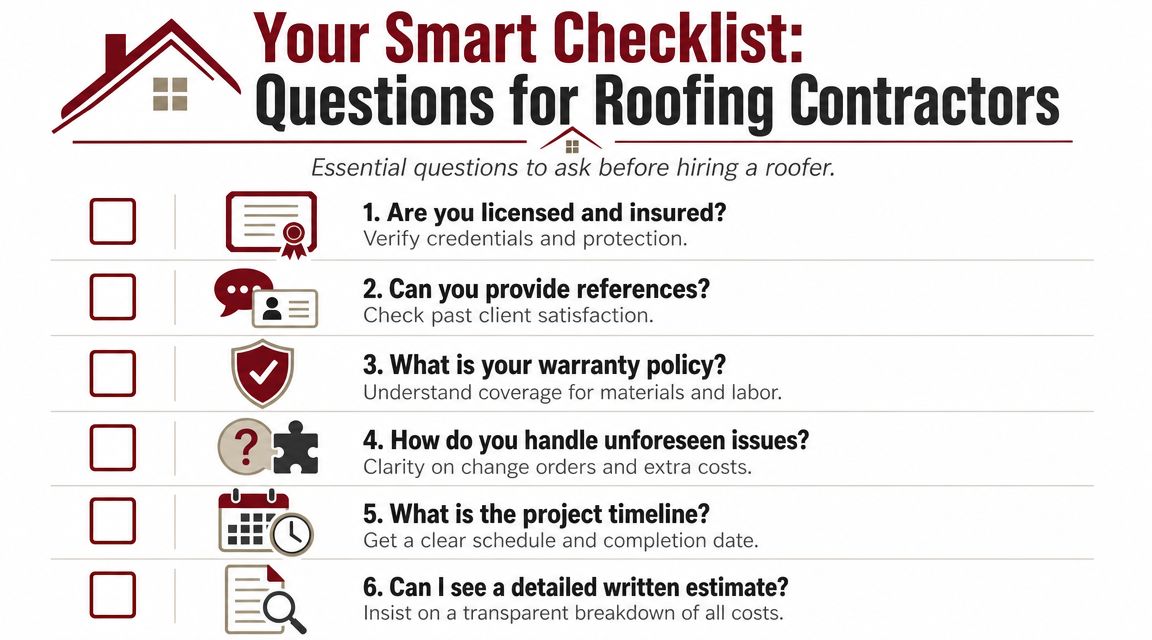
Smart questions that reveal the real scope
How will broken tiles be handled
Ask whether the estimate includes a breakage allowance and what happens if matching tiles are limited.What underlayment are you installing
Homeowners should hear a clear explanation of the product choice and why it fits a tile roof in Western Washington.Are flashing details included
A low quote may leave out metal work around penetrations and roof transitions.What happens if damaged wood is found
It's important to understand how change orders are handled before the tear-off begins.Will the estimate be itemized
A detailed proposal makes it much easier to compare one bid to another.Are you properly licensed, bonded, and insured for roofing work in Washington
That protects the homeowner if something goes wrong during the project.
Homeowners who want a more roofing-specific version can use this list of questions to ask a roofing contractor before signing anything.
If a contractor can't explain the bid in simple terms, that usually means the homeowner still doesn't have a clear picture of what they're buying.
Frequently Asked Questions
How do homeowners know if they need underlayment replacement or just a repair
If leaks keep returning, the roof is older, or the tile looks reusable but moisture is still getting in, underlayment may be the issue. A professional roof inspection can help confirm whether the problem is isolated or spread across the system.
Will insurance cover tile roof underlayment replacement
Sometimes, but it depends on the cause of damage and the policy language. Sudden storm damage may be treated differently than age-related wear, so homeowners should document what they're seeing and review the claim with both the insurer and a roofer.
How long does this kind of project take
The timeline depends on roof size, weather, access, and how much tile handling is involved. In Western Washington, rain can affect scheduling, so homeowners should expect the contractor to talk through weather planning and temporary protection.
Can the old tile usually be reused
Often, yes, if the tile is still in serviceable condition. That said, some breakage is common during removal and reset, especially on older roofs or fragile tile.
Is synthetic underlayment worth asking about
For many homeowners, yes. It often comes up on bids because it can offer a different balance of durability and handling than traditional felt, though the right choice depends on the roof and the contractor's recommended scope.
If you're trying to make sense of your tile roof underlayment replacement cost, the next step is a clear inspection and a quote that breaks the work down in plain English. Four Seasons Roofing helps Western Washington homeowners understand whether they need a repair, an underlayment reset, or a full replacement, so they can protect their home without guessing.